Good, experienced educators may be struggling with online teaching because they may still be using the same strategies employed in the traditional (brick) classroom. Also, there are many tools and apps available to enhance online learning, but technology alone does not make a synchronous class successful. It is imperative to remember that the 3 principles of effective synchronous classes emphasize mastering the art of patiently nurturing and growing the online learning community. Tech-integration is only secondary as it does not dictate the teaching, but serves the teacher’s plan in delivering or ensuring learning.
If a synchronous class is proving to be challenging, consider including the following aspects into your plan.
1. SET EXPECTATIONS
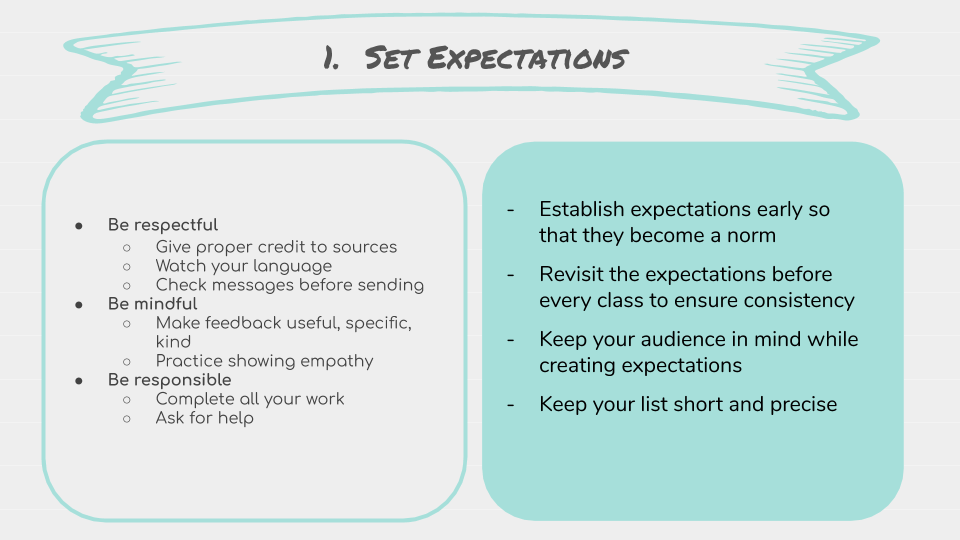
Learners are familiar with behavioral expectations in traditional classrooms. These expectations aid in establishing the class norm for the learners. It is essential to revisit and edit the list of expectations to suit the needs of the online learning environment, while keeping the school culture and policy in mind.
Just as a classroom contract might have been printed and signed to ensure student buy-in, consider various ways to get students to extend their support even in the online environment.
Establishing the expectations with learners and parents at the very first meeting ensures the ethos of your learning environment is preserved.
2. ESTABLISH PROCEDURES
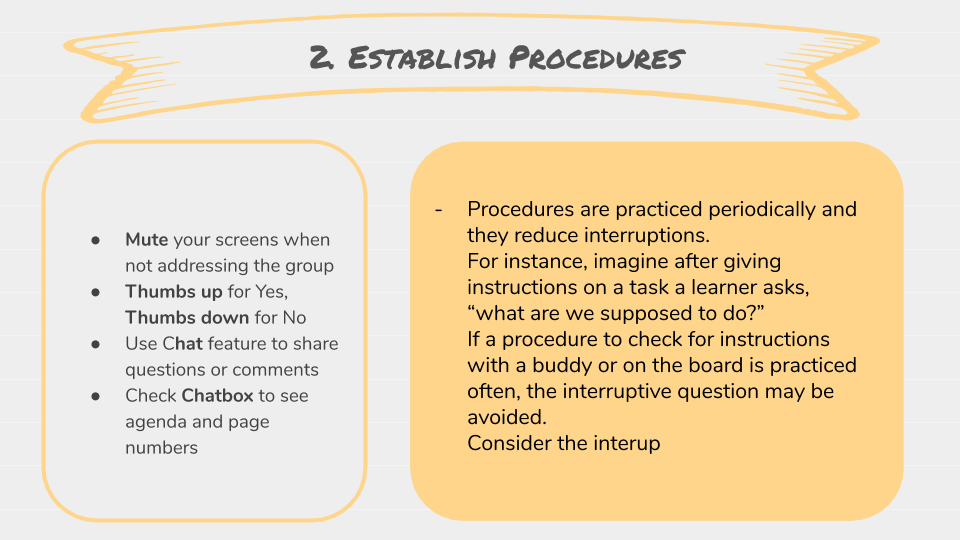
Procedures help the class run like a well oiled machine. Consider the various distractions your learners encounter and focus on minimizing those distractions by creating a procedure that will eventually become routine behavior. Keeping the list of procedures small, and setting time apart to practice the procedures help learners translate them into learned behavioral routines
3. SHARE THE AGENDA
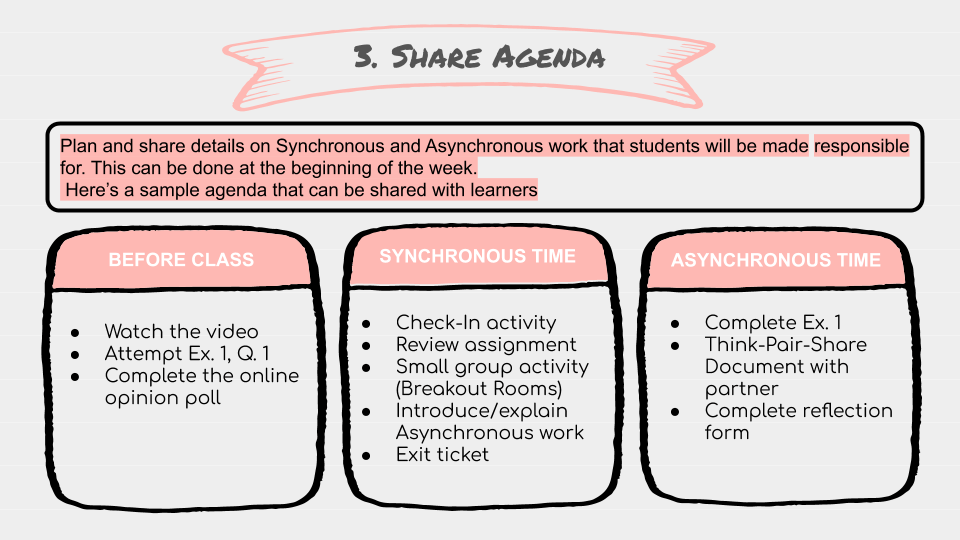
Most learners are also new to the online learning environment where they are working on the asynchronous activities on their own. High-school-aged learners have periodically articulated their needs better than younger learners have. They ask teachers for weekly plans, details on expectations, clarity on assigned activities, etc.. Though younger learners have the same need, they often lack the ability to think ahead and ask clarifying questions related to process.
Their needs can be addressed by clearly communicating instructions, expectations, and teaching concepts. Clarity can derived by sharing a weekly planner and all learning material in a centralized system and allowing parents to access the planners as well.
When making announcements, ensure that the message remains consistent across any platform it is shared on (ex. Google Classroom, Class Whatsapp Broadcast, Emails to parents, etc.).
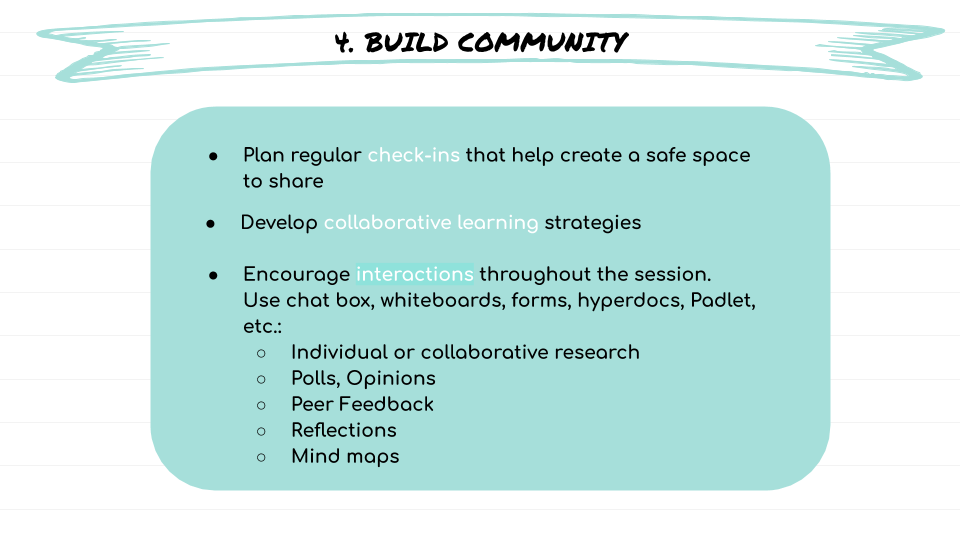
4. BUILD COMMUNITY
As mentioned in the introduction, the success of online education depends highly on the development of a healthy learning community that is based on genuine and active interactions between learners and their teachers or peers during synchronous classes. A sense of belonging and collaboration helps keep learners motivated and interested in the class.
5. RETHINKING TEACHING STRATEGIES
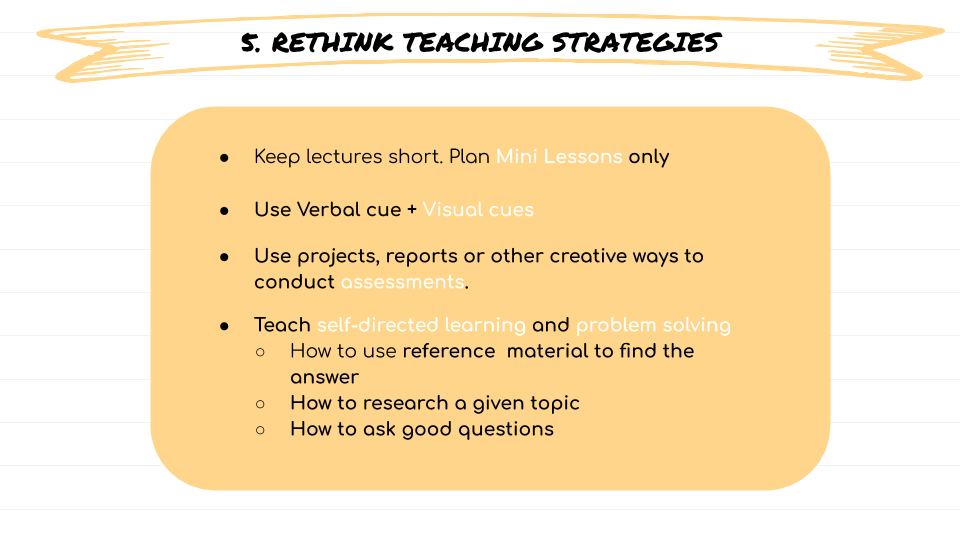
Consider a Flipped Classroom where instructions and concepts are presented in the home environment while the projects and assignments are completed in the class along with other learners. Similarly, while creating this blueprint for synchronous and asynchronous learning, both done in the home environment, often alone and without the support of a parent, consider how you can flip some of your teaching.
Since online education places a high demand on developing self-directed learners, teach learners to use reference material effectively. Students should learn to problem solve on their own. In fostering self-directed learning, teachers create mini-lessons in order to make time for increased active learning opportunities. Therefore, rethinking the design and delivery of the lesson, can create meaningful interactions for learners with the interface, and their peers or teachers during synchronous classes.
6. PROVIDE FEEDBACK
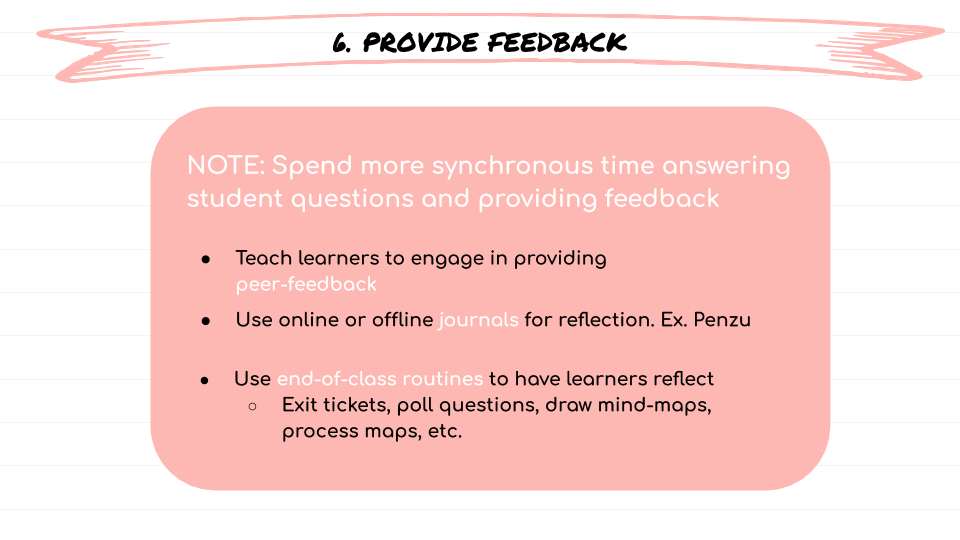
As one of the 3 principles of effective synchronous classes insists that student improvement is based on the quality (specific, useful, genuine) of feedback and quantity (reiterated, consistent reminders in writing, in discussion groups, etc.) of feedback.
Assessing and grading student material can be a challenge but there are various tools that can help provide the necessary feedback to the learner in written form or voice recordings. Some teachers take the most common mistakes made by learners and create a short video demonstrating how to avoid the mistake.
Providing real time, constructive feedback during synchronous classes not only increases student satisfaction, but also improves their performance. If you are still struggling with making time for giving feedback during your synchronous class time, consider Matthew Johnson’s advice on Flash Feedback with The Cult of Pedagogy.
7. CREATE YOUR TOOL KIT
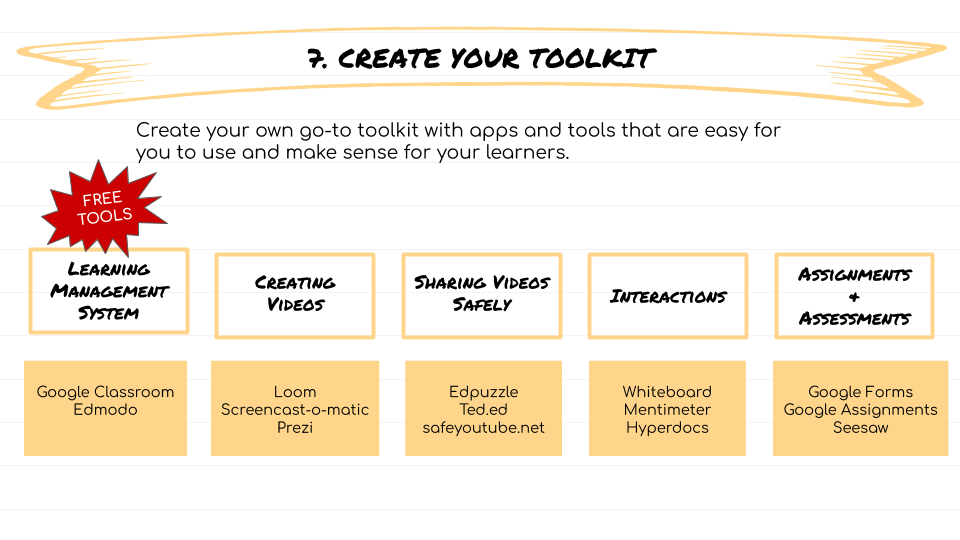
This is more of a tip than a strategy. There are several educational products for offline classes, and teachers are under no obligation to know them all. Schools and school districts have a certain publisher they prefer; most publishers have distributed several free online products.
Similarly, check with your publishers or education boards to familiarize yourself with the various LMS platforms. On the flip side, try out a few freeware products to see which ones fit your plan, are easy to use, and can be used routinely. Create a tool kit and use them routinely for the sake of consistency.
One the biggest deterrent to practicing new online teaching skills is believing that they are a temporary fix. Online learning has several benefits that can be adopted when traditional classes resume. Currently, the educational landscape in India may not return to traditional routines when the new academic year begins in June 2020. These reasons urge educators to embrace the new normal with all its challenges, while being aware that it is a challenge for us and our young learners.
Talking candidly with peers and learners about these new developments and ensuring a safe non-judgmental space for exchange of ideas will certainly aid educators in finding success in blended learning environments, especially their synchronous classes.
NOTE: Feel free to download the presentation for sharing the content at your school.
REFERENCES:
Gonzales, Jennifer (Producer). (2020, May 10). Flash Feedback: How to Provide More Meaningful Feedback in Less Time. Retrieved from https://www.cultofpedagogy.com/flash-feedback/
Sharoff, Leighsa. (2019). Creative and Innovative Online Teaching Strategies: Facilitation for Active Participation. The Journal of Educators Online. 16. 10.9743/JEO.2019.16.2.9.
Pearson (2020, March 24). 9 Strategies for Effective Online Teaching. Retrieved on 5/11/2020 from https://www.pearsoned.com/9-strategies-for-effective-online-teaching/.
University of Illinois, Springfield (n.d.). Instructional Strategies for Online Courses. Retrieved on 5/11/2020 from https://www.uis.edu/ion/resources/tutorials/pedagogy/instructional-strategies-for-online-courses/
Slide design – Sketchnotes Lesson, by Slidesgo.com

