As a teacher transitioning from traditional classroom room teaching to online classes, planning your real-time video conferencing session with learners, also known as the synchronous e-learning session, will be one of the skills you will master.
In distance or online education, learners receive material online and plan out their independent study. This was economical and provided flexibility, but as researcher Claire de la Varre et al. (2014) observed, completion rates in a purely asynchronous learning environment were low. Lack of regular check-ins, lack of external motivation, and/or lack of timely help from a teacher were some reasons associated with the high dropout/incompletion rate.
Therefore, Synchronous learning environments were introduced to ensure student satisfaction in distance education modules (Cao, Griffin, and Bai, 2009).
In contrast to the original purpose, the current crisis learning situation has repurposed synchronous classes from an essential aspect of distance (independent) learning to a substitute for traditional classroom learning. Most teachers who are teaching online for the first time consider online education and synchronous classes as a temporary and inconvenient substitute.
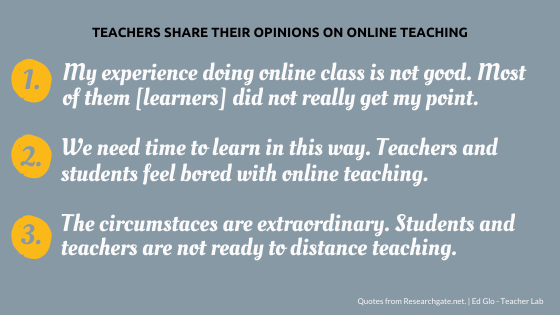
The pandemic has caused a surge of online learning business partnerships where organizations are building their capabilities to support more users. Even the tech giants like G-Suite for Education and Microsoft Teams are building safer and more user-friendly educational platforms, they are adding new features to their video conferencing tools every day, etc.. In addition, several free, accelerated training courses are helping teachers get trained in online teaching. These changes suggest an increase in blended learning opportunities even after the lockdown ends.
Synchronous e-learning can be a highly effective pedagogical alternative especially when teachers embrace it. Here are some research-based principles to conducting successful synchronous classes:
PSYCHOLOGICAL WELL-BEING
The first key principle of an effective synchronous class is ensuring psychological well-being of the learners. Similar to traditional classrooms, interactions within the synchronous e-learning environment can be optimized to create a sense of belonging and build a sense of ownership of the learning opportunities. Building a community is essential.
Woodcock, Sisco, and Eady (2015), in their study evaluating student feedback on synchronous classes found that, “building a learning environment on the foundations of: clear expectations, trust and care, closeness and cohesion, mutual respect, and a democratic space of equals, creates a sense of psychological safety among learners that enhances their e-learning self-efficacy and experience.”
Here are some ways to introduce intentional interactions that enhance a sense of belonging during synchronous interactions:
- Begin by setting clear expectations and guidelines, especially when engaging in conversation through talk or chat features. Vu and Fadde (2014) found that offering participation points each week encouraged healthy interactions between learners.
- Maintain consistency in communication. Teachers may send announcements through email, through Google Classroom, or a calendar notification with a checklist the day before the synchronous class meeting. Each message needs to remain consistent. For instance, if the email includes chapter names and page references, other messages must also include those details to make the communication effective. Teachers may also create multiple notifications, but add a link to one central portal for all the details.
- Have regular check-ins with your learners. Add a few SEL questions on Google Forms to understand your learners.
- Use a whiteboard app to create collaborative mind-maps or play a game based on the topic being discussed.
STUDENT INTERACTIONS
The second key principle of an effective synchronous class is including multiple and meaningful student interactions. Live virtual classes can facilitate real-time interactions between learner and instructor, learner and learner, learner and content, as well as learner and interface (Martin, 2012). Using multi-modal representations, interactions can be facilitated in the following ways:
- Reduce teacher talk-time by creating a mini-lesson. Focus your mini-lesson on one or two key concepts that learners will need to know in order to complete their asynchronous tasks for the week.
- To increase student interactions with the interface and with you, elicit opinions on the topic you want to cover in your mini-lesson by polling your students or creating a word cloud using Mentimeter.
- Many video conferencing apps allow the host to create breakout rooms to facilitate small group discussions. Use this feature to increase peer interactions. After your mini-lesson, split learners into small groups where they solve or discuss the process of solving a problem.
- Add collaborative activities while revising a topic. Share a document that can be edited by multiple users. For instance, a shared Google Doc or Google Slides allows multiple learners to enter their responses in real-time. This could end with discussions where you provide useful feedback to your learners in real-time.
- Conduct a real-time online quiz using Quizlet or Kahoot.
PROVIDING FEEDBACK
The third key principle of an effective synchronous class is providing timely, useful and specific feedback. According to Racheva (2018), “From the student’s perspective, synchronous virtual learning allows for immediate feedback in the form of “just-in-time clarification and information.” and that, “The key role of the tutor here is to create an atmosphere of positive feedback by guiding the group’s interaction.”
Especially when dealing with abstract concepts, teachers can increase class participation, elicit reflections, and provide actionable feedback.
- After learners complete a collaborative activity, teachers acknowledge the positive aspects of the discussion, as well as provide actionable feedback on the next steps. The entire reflection-feedback process creates a constructive ethos within all group interactions.
- Learners can complete collaborative documents and be encouraged to follow your example in providing peer feedback that is reflective, constructive, and positive.
- Developing journaling skills to build metacognition. Use online journals like Penzu or create an email thread where learners practice writing guided reflections. At the end of the unit, encourage learners to select parts of their reflection to create a timeline of their learning experiences.
These three principles definitely do not replace the intuition of a teacher. But they are research-based principles that will only aid in the practice of developing synchronous online learning experiences.
References
Cao, Qidong & Griffin, Thomas & Bai, Xue. (2009). The Importance of Synchronous Interaction for Student Satisfaction with Course Web Sites. Journal of Information Systems Education. 20.
Claire de la Varre, Matthew J. Irvin, Adam W. Jordan, Wallace H. Hannum & Thomas W. Farmer (2014) Reasons for student dropout in an online course in a rural K–12 setting, Distance Education, 35:3, 324-344, DOI: 10.1080/01587919.2015.955259
Fleming, N. (2020, April 24). Why are some kids thriving during remote learning? Edutopia.og. https://www.edutopia.org/article/why-are-some-kids-thriving-during-remote-learning
Woodcock, S., Sisco, A., & Eady, M. (2015). The Learning experience: training teachers using online synchronous environments. Journal of educational research and practice, 5(1), 21-34. https://doi.org/10.5590/JERAP.2015.05.1.02
Vu, Phu & Fadde, Peter. (2013). When to talk, when to chat: Student interactions in live virtual classrooms. Journal of Interactive Online Learning. 12. 41-52.
Racheva, Veronica. (2018). Social aspects of synchronous virtual learning environments. AIP Conference Proceedings. 2048. 020032. 10.1063/1.5082050.
Smekens Education Solutions (2019, March 1). Execute Mini-Lessons in 4 Steps. https://www.smekenseducation.com/Execute-MiniLessons-in-4-Steps0.html
Martin, Florence & Parker, Michele. (2014). Use of Synchronous Virtual Classrooms: Why, Who and How? MERLOT Journal of Online Learning and Teaching, 10, 2, 192-210.. MERLOT Journal of Online Learning and Teaching. 10. 192-210.
Clark, Felice (n.d.). Head in the Clouds Idiom Story. Retrieved from https://www.teacherspayteachers.com/Product/Head-In-The-Clouds-Idioms-Story-533865
Landis, S. and Highfill, L. (n.d). Six Word Memoir. Retrieved from https://docs.google.com/presentation/d/1kAHo16Kt0JF0mrVzmXHgzrqW9bTQDTrvLoKBfJJe43c/edit#slide=id.p


2 thoughts on “Three Principles of Effective Synchronous Classes”