Introduction:
21st-century skills have had various definitions and criteria associated with them. The 4C’s – Communication, Collaboration, Critical Thinking, and Creativity – are popularly associated with the idea of 21st-century skills.
In Influence of P21, SCANS and DeSeCo on 21st Century Skills, I’ve looked at the genesis of the 21st-century skills within the US and the OCED.
This article will look more closely into the vocabulary used to identify 21st-century skills and the frameworks created to apply these skills in the classroom.
Globally Competent Learner
One vocabulary word to consider is ‘globally competent learner.’ This does not mean that learners have to be well-traveled or well-read or elite. Association for Supervision and Curriculum Development (ASCD) has formulated the Globally Competent Learning Continuum (GCLC), which is based on the needs of today’s’ learners:
“students we teach have diverse experiences, backgrounds, and perspectives and engage in a world that is interconnected and interdependent. Therefore, an integral part of a whole-child approach to education involves instilling in students the mindsets, knowledge, and skills they need to live and work as citizens in a global society.”
ASCD (2019)
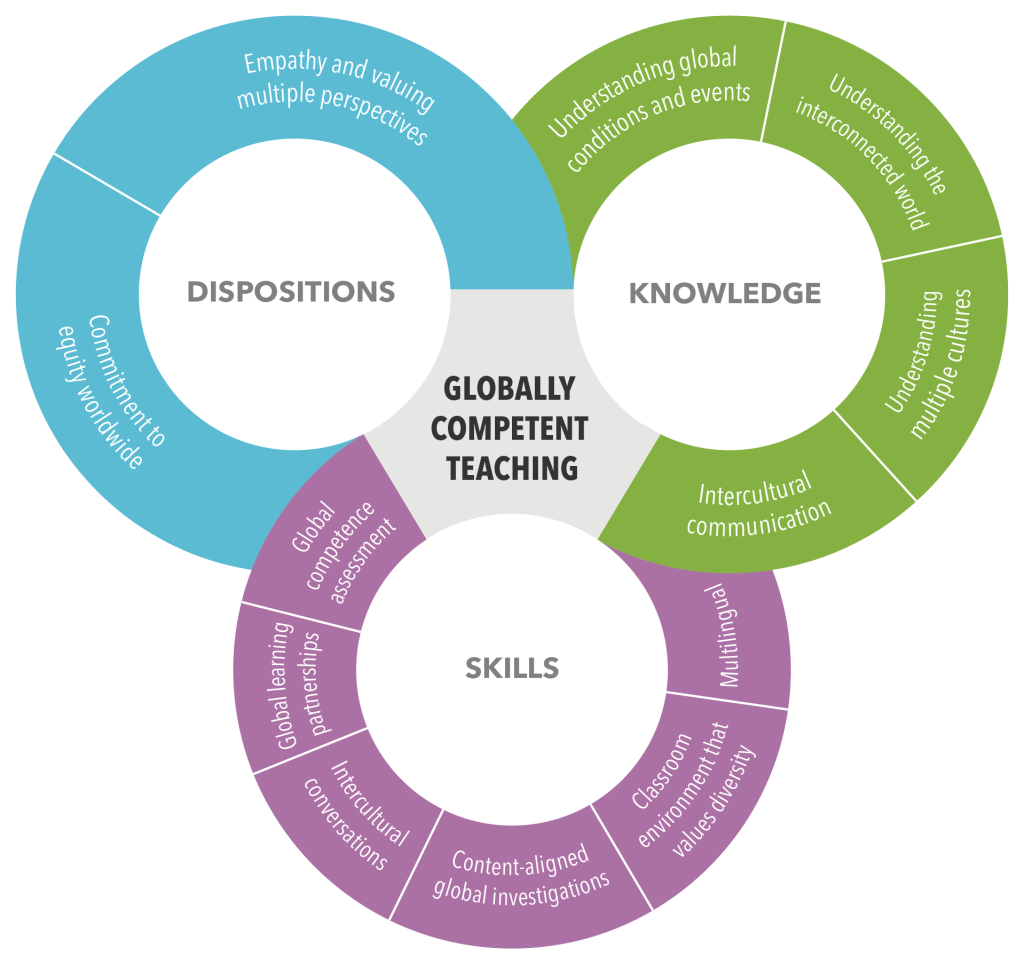
Senan uses the phrase “citizen in the 21st century,” to describe globally competent learners as students who, “need to learn how to be good critical thinkers, communicators, and collaborators. They need to be tech-savvy, globally aware, and financially intelligent, too (Senan, 2013).”
According to Australia’s Global Education Program (GEP) framework of educating globally competent learners, they want their students “to take responsibility for their actions, respect and value diversity and see themselves as global citizens who can contribute to a more peaceful, just and sustainable world (GEP, 2011).”
Impact of Politics, Economics, and Technological Advances on Curricula
Writing for ISTE on digital literacy, Escobar notes that, “Research shows that even though students use technology frequently and massively, they do not possess the skills needed to take full advantage of technology’s potential.” Observing that learners lack the cognitive skills to make full use of the technology at hand, she suggests that, “it’s crucial to incorporate these [digital/technological] skills into each country’s curriculum so they become a part of teachers’ quotidian practice and part of everyday life in schools (Escobar, 2015).”
Australia’s framework for global perspectives highlights the need to equip learners with, “the knowledge, critical thinking skills, and emotional literacy to engage in democratic decision-making (GEP, 2011).” The framework also looks to raise awareness and interest in the issue of economics and social justice (GEP, 2011).
In creating a curriculum that incorporates 21st-century skills to build a globally competent learner, Higgins asks for a balance between the traditional ‘‘essence of true education is timelessness’’ perspective and that of the “younger and more inventive members of the tribe on practical and applicable skills [required] for the contemporary world (Higgins, 2014).”
Therefore it is important to note that as much as the current trends in economics, politics, and technological advances inform curriculum creation, the opposite is also true. The learners growing up exposed to skills that Senan highlights – adaptability, complex communication and social skills, non-routine problem solving, self-management/self-development, systems thinking – would certainly exert their influence on economics, politics, and technological advances as well.
Personal Learning and Teaching Experience with 21st Century Skills
My introduction to any of the 21st-century skills as listed in the different articles never included the breadth or depth of vocabulary and information that we currently use in the classroom.
Many times, the “perennial” skills from the previous century, the 4 C’s, are seen as inherent parts of a lesson plan. For instance, getting students to work on a project together, or allowing students to self-correct a formative test was interpreted as the inclusion of 21st-century skills.
In addition to the perennial skills, Higgins highlights another category of 21st-century skills known as the ‘‘contextual’’ skills that are unique to this century, such as decision making in data mining of large quantities of digital information. These skills were unheard of 25 years ago.
The school I currently work at has adopted the Cambridge Pathway curriculum. The curriculum has three aspects of teaching-learning that ensure the incorporation of 21st-century skills. First, the five learner and teacher attributes of a Cambridge learner that needs to be incorporated into the fiber of the school: Responsible, Innovative, Confident, Engaged, and Reflective. Second, Global Perspectives, a college readiness program that can be initiated from Middle School to A-Levels that involves being globally aware, introducing ethical research practices, project-based learning coupled with literacy and numeracy skills. And finally, a pedagogical push towards Active Learning and Assessment for Learning (Özden, 2019).
Effective teaching practices that revolve around these three ideologies should create a more student-centered learning environment that promotes student agency, interdisciplinary learning, literacy and numeracy, self-regulation, and metacognition.
More importantly, the 21st-century skills included in today’s curriculum are measurable. Schleicher observes that “the teaching profession is not just a static attribute of culture but has, in some countries, changed significantly (Schleicher, 2012).” Teachers use data to make informed decisions on student progress and interventions.
As a concluding thought, I’d like to highlight that in my experience, the incorporation of the 21st-century skills does not replace rigor of practice or depth of content knowledge as they are just as important for students to be college-ready, and in-turn, globally competent.
References:
- ASCD (2019). The Globally Competent Learning Continum. Retrieved on 9/25/2019 from http://globallearning.ascd.org/lp/editions/global-continuum/home.html
- Higgins, S. (2014, Oct 29). Critical thinking for 21st-century education: A cyber-tooth curriculum? Springer-2014. Pg.559-574. DOI 10.1007/s11125-014-9323-0
- Senan, D.C. (2013, Nov). Infusing BSCS 5E instructional model with multimedia: STA promising approach to develop 21 century skills. i-manager ’s Journal, Vol(2) pg.1-7.
- Özden, C. (2019, Sep). An international education from Cambridge – What Lies At the Heart of Our Approach. Retrieved from https://www.cambridgeinternational.org/Images/417448-overview-brochure.pdf
- Schleicher, A. (2012), Ed., Preparing Teachers and Developing School Leaders for the 21st Century: Lessons from around the World, OECD Publishing. http://dx.doi.org/10.1787/9789264xxxxxx-en
- Escobar, M.C. (2015, July 14). 21st-century skills: What has been accomplished, why should we care? Retrieved from https://www.iste.org/explore/entrsekt/21st-century-skills%3A-What-has-been-accomplished%2C-why-should-we-care%3F
- Rae, L., Baker, R., and McNicol, C. (2011). Global Perspectives: A Framework for Global Education in Australian Schools. Retrived from https://www.globaleducation.edu.au/verve/_resources/GPS_web.pdf

