This article draws information on Intercultural Mindedness (IM), International Literacy (IL), and Global Competency (GC) from the articles assigned for reading and the Venn Diagram created by the cohort
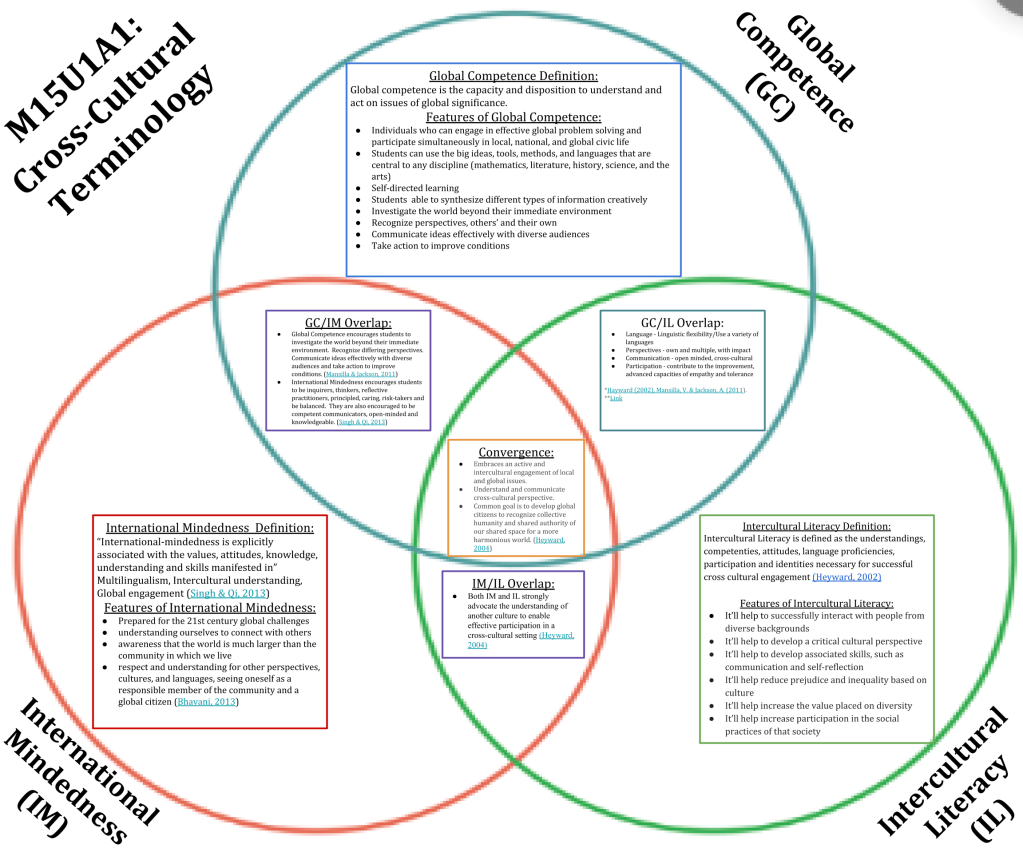
I. Intercultural Literacy
Mark Heyward, in his 2002 article, From International to Intercultural – Redefining the International School for the Globalized World, defines intercultural literacy as successful cross-cultural engagements. This would involve the understandings, competencies, attitudes, language proficiencies, participation, and identities necessary for successful living and working in cross-cultural settings. (Heyward, 2002).
In Haywards own words, “…since intercultural literacy is defined in terms of successful cross-cultural engagement it requires a cross-cultural experience.” The key features of a cross-cultural exchange that lead to successful education of IL are identified in the Venn Diagram as follows:
- It’ll help to successfully interact with people from diverse backgrounds
- It’ll help to develop a critical cultural perspective (multiple perspectives)
- It’ll help to develop associated skills, such as communication and self-reflection
- It’ll help reduce prejudice and inequality based on culture
- It’ll help increase the value placed on diversity
- It’ll help increase participation in the social practices of that society
Hayward’s predecessors had narrow definition of cultural literacy that begins with culture shock and moves towards acceptance of the host culture. Building on their work, Hayward created his own Multidimensional Model of International Literacy, where learning is the primary focus, instead of adaptation or acculturation, and pluralism is the intended effect (Hayward, 2002).
Heyward draws various parallels between international schools and local (host country) schools. In this he stands apart as he identifies the need for IL is greater in international schools as the cultural divisions are many. Therefore, he suggests the development of the curriculum and assessment are crucial for international schools (Heyward, 2002).
II. International Mindedness
International Mindedness (IM), a phrase that was mostly popularized by International Baccalaureate, was introduced by Leech and the ISA in the 1960s to indicate, among other things, cultural diversity, international mobility, and intercultural understanding and awareness of global issues.
In 2014, Dr. Sriprakash, Singh, and Dr. Jing, conducted a qualitative study with IB schools across three different countries to determine the exact definition and nature of IM. The study recognizes the struggle to create a single definition for IM and instead presented a matrix that highlights the nuances the field has to offer (Dr. Sriprakash et al, 2014).
The Venn Diagram lists three-key features that need to be considered in defining IM: global engagement, multilingualism, intercultural understanding.
IM learners at the IB schools are expected to demonstrate proficiency in following ten different attributes are aligned with the above mentioned key-features: communicator, open-minded and knowledgeable, inquirers, thinkers, reflective practitioners, principled, caring, risk-takers, and balanced.
As noted in the Venn Diagram, these attributes ensure respect and understanding for other perspectives, cultures, and languages, seeing oneself as a responsible member of the community and a global citizen (Bhavani, 2013). In addition, IM allows learners to embrace knowledge and critical thinking skills needed to analyse and propose solutions about global issues and their interdependence, especially those relating to cultural differences (Dr. Sriprakash et al, 2014). Finally, to recount Ian Hill, IM should produce in our learners, “…empathy, compassion and openness to the variety of ways of thinking which enrich and complicate our planet (Hill, 2015).”
IM places much emphasis on cultural perspectives and multilingual approaches, which is similar to what Hayward asserts is necessary for IL. However, while IL requires learners to navigate host cultures successfully in order to form pluralistic connections, IB dives into the micro culture to identify various community based needs that students can navigate. For instance, elitism vs. compassion in one region, western cultural currency in another, or caste lines or equitable practices in a third society (Dr. Sriprakash et al, 2014).
It is important to notice that in all of the three above mentioned case studies, IB looks at cross-disciplinary methods of teaching and learning to problem solve.
III. Global Competency
In 2011, the Asia Society Partnership for Global Learning and The Council of Chief State School Officers published Educating for Global Competence: Preparing Our Youth to Engage the World by Mansilla and Jackson, as a, “catalyst and resource” for “educators, administrators, policymakers, community leaders, parents, and students,” to help turn 21st century skills into classroom practice (Mansilla & Jackson, 2011).
Global competence is simply defined as the capacity and disposition to understand and act on issues of global significance.
The key features of GC as listed in the Venn Diagram are:
- Individuals who can engage in effective global problem solving and participate simultaneously in local, national, and global civic life
- Students can use the big ideas, tools, methods, and languages that are central to any discipline (mathematics, literature, history, science, and the arts)
- Self-directed learning
- Students able to synthesize different types of information creatively
- Investigate the world beyond their immediate environment
- Recognize perspectives, others’ and their own
- Communicate ideas effectively with diverse audiences
- Take action to improve conditions
The authors advice to use the interdisciplinary approach to nurture intercultural sophistication in students as they are provided various opportunities to examine what happens when cultures meet— in their neighborhood, classroom, or virtually (Mansilla & Jackson, 2011).
Therefore, globally competent learners can be identified (or assessed) based on a learners ability to be aware, curious, and interested in learning about the world and how it works.
Once again, the similarities between GC, IM and IL lie in some of the key words:
- Perspectives
- Communication
- Language/Multilingual
- Intercultural
- Interdisciplinary/Cross-disciplinary education
- Reflective
Even though the text in the GC manual by Mansilla & Jackson does not claim that it is intended primarily for international schools, the examples and case studies listed in the manual are all from various international schools around the world. Therefore, another similarity among IL, IM and GC is that they were authored with the context of international schools in mind.
VI. Personal Reflection
The articles considered for the comparative study were all geared towards one specific audience: International Schools. However, 21st century skills listed in the previous sections are all skills need to be taught universally.
I’m conflicted about the idea of IL or cross-cultural literacy being more applicable to International Schools. A few case studies included terminology such as “host country,” and “local school,” as the receivers of the cross-cultural exchange. The truth is both the international school and the local school are learning the same skills and need to be taught, assessed, commended for the same list of 21st century skills.
In conclusion, I’m reminded of the Shakespearean quote, A rose by another name would smell as sweet. IL, IM, and GC have similarities and differences, strengths and flaws, but they all address very similar key features and contexts. According to the research, they have all been tested in classroom settings and thus prove as resource guides. It is available for any school to consider training and implementation of these values.
“It is our duty to equip this growing generation, irrespective of class, with willing bodies. It is our duty also to train them in self-discipline.”
Kurt Hahn
REFERENCES
- Mansilla, V. & Jackson, A. (2011). Educating for Global Competence: Preparing Our Youth to Engage the World. New York, NY.
- Heyward, M. (2002). From International to Intercultural. Journal of Research in International Education, London. Vol. 1(1) Pg.9-32.
- Dr. Sriprakash, A., Signh, M., and Dr. Jing, Q. (July 24). A comparative study of international mindedness in the IB Diploma Programme in Australia, China and India.
- Hill, I. (2015, November). What is an ‘international school’? Part One. International Schools Journal Vol 35 (1). (pg. 60-70).
- Bhavani, J. (2013). Proceedings from IB Conference of the Americas 2: Innovate, Educate, Create. New Orleans, LA.
- Hahn, K. (1936, March). Education and Peace: The Foundations of Modern Society. The Inverness Courier. Retrieved on 9/18/2019 from http://www.kurthahn.org/wp-content/uploads/2016/04/ed_peace.pdf

