A. History of International Schools
Influence of Kurt Hahn on International Schools
“Patriotism does not become diluted; on the contrary, it grows up stronger and nobler by including the love of humanity. I have no respect for the tribal fervour which extols one’s own virtues and blinds one to the virtues of one’s neighbours.”
Kurt Hahn. The Inverness Courier; March 24, 1936.
Kurt Hahn had a vision for education as a tool for creating peace. His contribution to education was to prove, in a post-World-War-2-world, that education can redefine patriotism centered on ‘love of humanity’ instead of one that creates a divide between castes, nationalities, religious groups, socio-economic groups, etc. This ideology can still be applied today to address issues that arise with globalization.
Hahn’s education allowed young people to develop agency and self-motivation through experiential learning. He was confident his method would work to the point where he challenged fellow educators to test the curious minds of the boys from Salem (Hahn, 1936). However, today’s ideology expects students as young as 16 years of age to choose a major or focus, and the means to deviate from this decision could be impossible or very expensive. Interdisciplinary education is practiced far and in-between.
The Salem School for boys, instituted by Hahn, was built on the following 7 principles that he believed would equip ‘Anti-Lout’ students with willing bodies, trained in self-discipline:
- Give the children opportunities for self-discovery.
- Make the children meet with triumph and defeat.
- Give the children the opportunity of self-effacement in the common cause.
- Provide periods of silence.
- Train the imagination.
- Make games important but not predominant.
- Free the sons of the wealthy and powerful from the enervating sense of privilege.
International Baccalaureate
The Salem School website credits Kurt Hahn as, “not “only” a co-founder of our school, but also one of the educators who helped draft the first internationally accepted high school diploma,” the International Baccalaureate (IB) Program.
Headed by Robert Leech and the team of ISA members in the 1960s, the creation of the IB program included these 5 characteristics in the definition of an international school (Hill, 2015):
- Student diversity: culturally diverse.
- The governing structure and control: internationally mobile student and governing body with no one national group or government in control.
- The nature of the educational program: an education for intercultural understanding and awareness of global issues, what we might call international-mindedness.
- The legal status: not-for-profit status.
- Raison d’être of the school: international mindedness.
According to Dr. Ian Hill, Deputy Director General of The International Baccalaureate Organisation (2002 – 2012), the IB Program has since evolved in theory and practice.
At the October 2009 World Conference of Heads of IB Schools in Seville, it was acknowledged that landscape of IB has changed. The IB has placed emphasis on increasing access to its programs for students who could not previously access them. State and public schools, even with a homogeneous demographic, can now adopt the IB curriculum (Hill, 2015). This can include the IB framework for Primary Years (3yrs-12yrs), Middle Years (11yrs-16yrs) and IB Diploma (16yrs – 19yrs).
B. Defining International Schools
Many scholars have contended existing definitions of International School or International Education as they find the criteria chosen to define international school or international education limiting.
In 1964, Knight and Leech identified 7 different classifications of international schools. This is believed to be the first attempt at classifying international schools (Hill, 2015). Others, such as Hayden and Thompson (2013) and Bunnell (2014) have also tried classifying international schools.
However, Hill introduced four criteria and descriptors for being an international school which maps the descriptors to a number grade (Ex. 0 – 5) and in doing so, enables observers to determine if a school is more national or international in their approach (Hill, 2016).
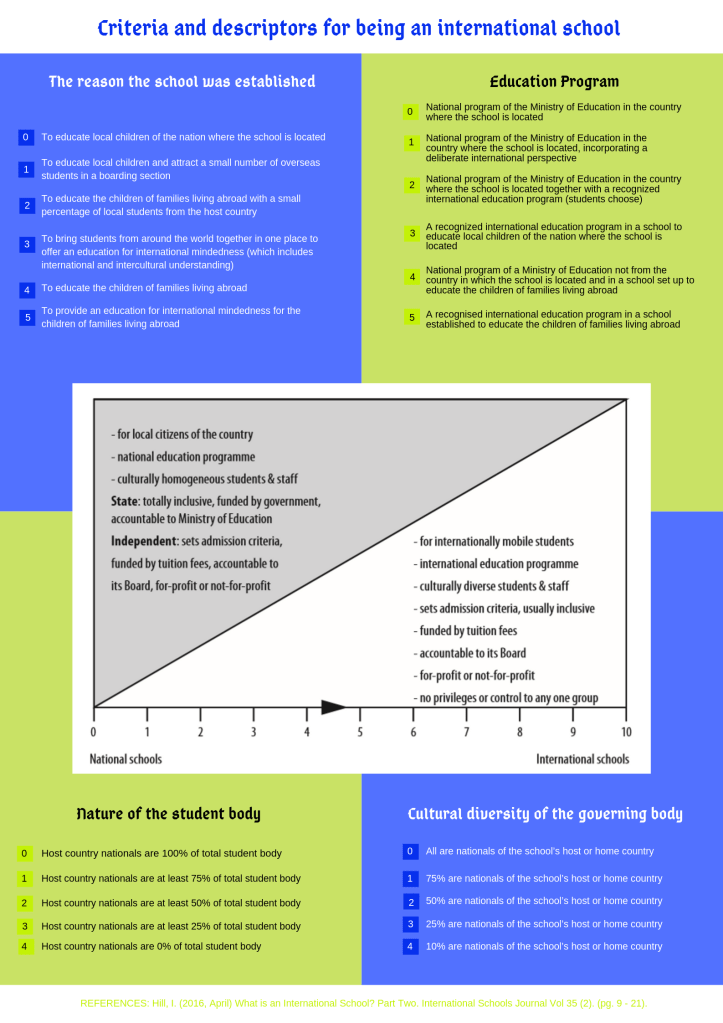
Additionally, ISC Research, the leading provider of English-medium K-12 international school data, trends and intelligence identifies a school as an international school if:
The school delivers a curriculum to any combination of pre-school, primary or secondary students, wholly or partly in English outside an English-speaking country. OR, a school is in a country where English is one of the official languages, it offers an English-medium curriculum other than the country’s national curriculum and the school is international in its orientation.
ISC Research
On a personal note, I prefer Hill’s mapping of characteristics to determine type of school – national or international. ISC Research has a much narrower viewpoint as it lays emphasis on English as the language of instruction. Similar to Hill’s mapping, ISC Research also distinguishes between schools that follow local boards vs. an international board.
However, I believe another aspect to consider while defining international schools is teaching staff. Maybe Teachers are currently being grouped with the governing body, and hence lack a mention in both Hill and ISC Research’s definitions. But since teachers and governors/owners are distinctly separate in form and function, I believe it is important to include a fifth category: International-mindedness of the teacher, where teachers (trained or traveled) are aware of the global and cultural perspectives and issues. They respect diversity and encourage it among students; Teachers who are trained to deliver the international curriculum in a way that fosters peace and understanding of their community.
Making teachers a part of the criteria for defining international schools was captured by Hayden and Thompson in their 1995 research involving 3000 students on what it means to experience international education. In the feedback provided by one of the participants who had attended an international school she explained that she had received a, “western education, because everything I was taught was delivered in a western point of view since all the teachers were from the west (Hayden & Thompson, 1995).”
C. Growth of International Schools
International schools are gaining momentum in various parts of the world, for different reasons.
Among the various categories of international schools those characterized as ‘non-traditional’, market-driven for the local elite, predominantly for-profit, may incorporate a mission to promote international understanding and peace (but not as their primary raison d’être), are the most recent manifestation of international schools which have been booming in places like Dubai and India since about ten years (Hall, 2015, 63). Cambridge Assessment International Education (CIE) offering IGCSE and A-Levels is one of the most common international curricula in India and Dubai.
The US has also observed a shift in international education within the last decade where some schools (public or private), and in some cases, entire school districts (public school system), are adopting the IB program. Despite criticism against the price points, depth vs. breadth of content knowledge, hidden costs of teacher training, etc., IB is becoming a popular choice for schools across demographics and is being considered an equitable option. For instance, a 2010 New York Times article by Lewin claimed, Bill and Melinda Gates Foundation gave the program [IB] a three-year $2.4 million grant to prepare low-income and minority students to participate in the I.B.
D. Personal Reflection
As previously stated, India has experienced an influx of international schools. Having worked at IGCSE/A-Levels schools in Mysore, I’ve noticed one board in particular that has become a popular choice for international accreditation and licensing – Cambridge Assessment International Education (CIE).
Though priced higher than its competitor, Edexcel, CIE has worked towards integrating the IGCSE curriculum into the local framework of the various nations it operates in. This is especially important when college admissions within the national state are concerned, as the host countries have different qualifiers for higher education. By making certain accommodations, such as regional language choices or flexible exam calendars, CIE ensures that local students have the same opportunities as globally-mobile students.
The city of Bangalore currently has the most number of CIE-based international schools in the country, which are competing against two to three nationally driven education boards (CBSE, ICSE, and State Boards). The tuition for attending the CIE schools are often 4 times higher than the national boards. If the school chooses to employ international teaching staff, are signed up as a Cambridge Pathway school, etc., the costs can be approximately 10 times higher than national boards.
The American, Canadian, or IB schools are few and far apart compared to CIE schools. However, the primary issue that I’ve noticed is the teaching-learning paradigm. Though CIE introduces Learner Attributes geared towards building global citizens, it is often neglected or implemented poorly, This is mostly because of the staff, who are experienced and qualified to teach content, but not international-mindedness.
Increased rate of attrition among teachers is another problem within the international school community. As new international schools are introduced each year in an expanding urban context, teachers are poached from the existing international schools.
Memberships with organizations like Alliance for International Education (AIE) or Council of International Schools (CIS) are rare as CIE has created a unique platform for its members that is a source of pride for the entire school community.
A larger number of new graduates entering the workforce are considering teaching as a profession as the number of international schools rise. The schools also pay a relatively lucrative salary and the occupation is preferred to call centers or other options that were lucrative in the early 2000s.
Several teacher training courses and colleges are becoming popular in the city of Bangalore, ranging from Montessori certification to the Azim Premji School of Education. The potential for organizations like Educational Collaborative for International Schools and its partnership with TEACH-NOW Graduate School of Education, presents the new wave of young teachers with more options for training.
Therefore, it can be observed that although the landscape of international education is evolving rapidly in India, equitable practices, globally aware students, and the raison d’être have taken a backseat to promote social elitism.
REFERENCES
- Hahn, K. (1936, March). Education and Peace: The Foundations of Modern Society. The Inverness Courier. Retrieved on 9/18/2019 from http://www.kurthahn.org/wp-content/uploads/2016/04/ed_peace.pdf
- Hill, I. (2015, November). What is an ‘international school’? Part One. International Schools Journal Vol 35 (1). (pg. 60-70).
- Hill, I. (2016, April) What is an International School? Part Two. International Schools Journal Vol 35 (2). (pg. 9 – 21).
- Schule Schloss Salem (n.d.). Reaching Goals with Confidence and Self-Reliance. Retrieved on 9/18/2019 from https://www.schule-schloss-salem.de/en/living-and-learning/years-10plus-11-12
- ISC Research (n.d.) Who We Are. Retrieved on 9/18/2019 from https://www.iscresearch.com/about-us/who-we-are
- Lewin, T. (2010, July 2). International Program Catches On in U.S. Schools. New York Times – Education. Retrieved on 9/18/2019 from https://www.nytimes.com/2010/07/03/education/03baccalaureate.html
- Hayden, M.C. and Thompson, J. J. (1995). International Schools and International Education: A Relationship Reviewed. Oxford Review of Education, September 1995, Vol. 21.

