While preparing to transition into a leadership role in a different culture, the following three resources help highlight cultural differences, similarities, and the associated significance: Various dimensions of national culture by Lewis and Hofstede, the GLOBE project’s framework for culturally endorsed leadership theory, and Cultural intelligence by Julia Middleton. The resources provide the following three key takeaways while analyzing the importance of learning about a different culture:
- Understanding the cultural norms and beliefs of host country
- Understanding the expectations and practices of leaders within that host country
- Navigating interpersonal core and flex values in decision making
National Culture:
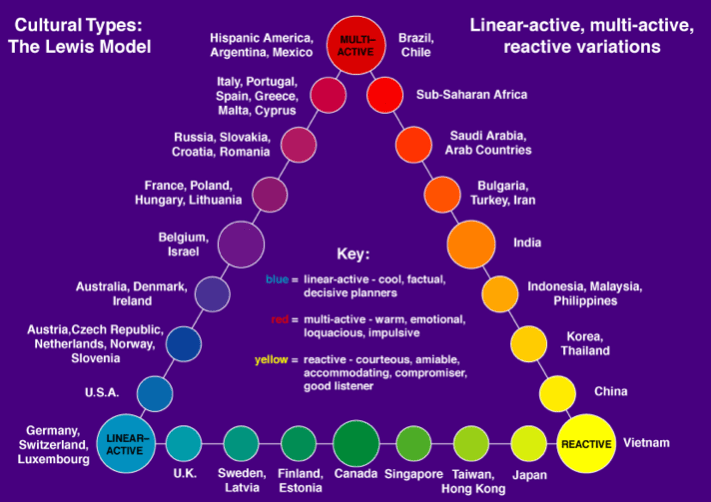
Richard D. Lewis defined three behavioral categories that define national cultures: Linear Active (factual, decisive planners), Multi-Active (emotional, impulsive, loquacious), and Re-Active (amiable, accommodating, good listener). Understanding these attributes is essential when moving to a different country.
One of the most simplest, yet significant examples is the concept of time in different cultures. Punctuality in a Linear-Active culture that values planning, is different from the concept of time in a Re-Active culture that values being accommodating. Leader or not, these simple yet profound indications make transitions into a different culture smoother.
Culturally Endorsed Leadership Theory (CLT):
The longitudinal GLOBE study identifies 6 dimensions that are universally accepted as essential characteristics in a leader: Charismatic/Value-based, Team Oriented, Self-Protective, Participative, Humane Oriented, and Autonomous. These dimensions are further broken down to ensure data collection is happening at the behavior and practice level and not merely knowledge or understanding level (Dorfman et al, 2012).
The GLOBE study revealed that CLT is a better predictor of leadership behavior than the national culture. For instance, theories defining national culture find that Southern Asians place value on status, Confucian Asia values networks of relationships built on trust, and the Anglo cultures place a premium on individualism. However, all three clusters, for varying reasons, find ‘Participation’ as a desirable characteristic in leaders (Ashkanasy, 2002).
Similarly, something I found interesting in the GLOBE studies is that responses to gender egalitarian practices revealed that people, least theoretically, want to respond positively to women in leadership, even when the national culture associates masculinity with competitiveness and assertiveness (Gunnell, 2016). This is something that might have changed over time and would be pertinent, for me as a woman in leadership to be aware of.
Core Vs. Flex:
Cultural Intelligence or cultural quotient (CQ) looks at the capability of a person to relate and work effectively across cultures (Middleton, 2015). The postmodern thinking of the late 20th century that highlights logic and relativism gives rise to the idea of Core values and Flexible beliefs. CQ allows individuals to consider interpersonal core and flex values in decision making and reasoning.
For instance, in Southeast Asian cultures, people in authority, and the elderly, would be addressed by “sir,” “madam,” or “master,” and never by their first or last name in certain South Asian cultures. My first time leading a team in South Asia, I held the core belief that salutations like “ma’am” would add distance between me and my team and decided to do away with it. Many people on the team considered my dismissal of a simple salutation related protocol to be noncommittal and indecisive. I had to flex my belief and find new avenues to reduce power distance.
Limitations and Conclusions:
GLOBE’s universally accepted dimensions through which effective leadership is measured provides a good springboard to help leaders transition into a new culture. But being aware of nuances and limitations is essential. Culture and expectations may change over time. Narrow definitions of clusters may also produce variations within a particular culture. For instance, Iran, India, and Thailand belong to the South Asian cluster but have several distinct characteristics that might have been out of the context of the GLOBE study (Ashkanasy, 2002).
Ultimately, the significance of the role of culture in being an effective team player and certainly, an effective leader, is infallible and must be studied in the context of globalization.
REFERENCES:
- Dorfman, P., Javidan, M., Hanges, P., Dastmalchian, A., and House, R. (2012). GLOBE: A Twenty Year Journey Into The Intriguing World of Culture and Leadership. Journal of World Business. 47 (2012) 504-518. DOI:10.1016/j.jwb.2012.01.004
- Gunnell, M. (2016, Dec 16). A Comparison of the GLOBE and Geert Hostede findings and their Implications for Global Business Leaders. Retrieved on 9/1/2019 from https://www.linkedin.com/pulse/comparison-findings-globe-geert-hostede-implications-global-gunnell
- Ashkanasy, Neal. (2002). Leadership in the Asian century: Lessons from GLOBE. International Journal of Organizational Behavior. Vol 5(3), pg. 150 – 163.
- Tedx Talks (2015, Feb 20). Cultural intelligence: the competitive edge for leaders | Julia Middleton | TEDxEastEnd [Video File]. Retrieved on 9/2/2019 from https://www.youtube.com/watch?v=izeiRjUMau4
- Cross Culture, (2015, June 22). The Lewis Model – Dimensions of Behaviour. Retrieved on 9/2/2019 from https://www.crossculture.com/the-lewis-model-dimensions-of-behaviour/

