WHY USE PRE-ASSESSMENTS:
Pre-assessments can be evaluated for knowledge gaps, student interest, readiness level, and to identify student needs while incorporating differentiation practices.
For this week’s assignment, I’ve chosen Geometric Measurement for Grade 7 students, to demonstrate how pre-assessments can lead to learner-based differentiation. The lesson is based on Common Core Standards. Students will be learning to solve for perimeter and area of 2D shapes such as quadrilaterals, parallelograms, triangle, polygons, and circles. They will also learn to solve for surface area and volume of 3D shapes like cubes and right prisms. Finally, students will apply their learning to solve real-life problems.
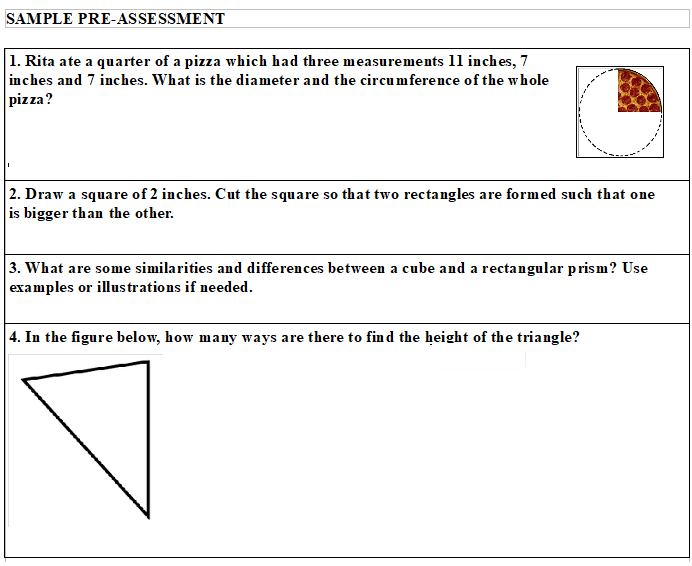
The pre-assessment sample checks for understanding of prior knowledge (CCSS) from Grade 5 Geometry that is required for the current lesson: CCSS.MATH.CONTENT.5.G.B.3 and CCSS.MATH.CONTENT.5.G.B.4
HOW TO DIFFERENTIATE:
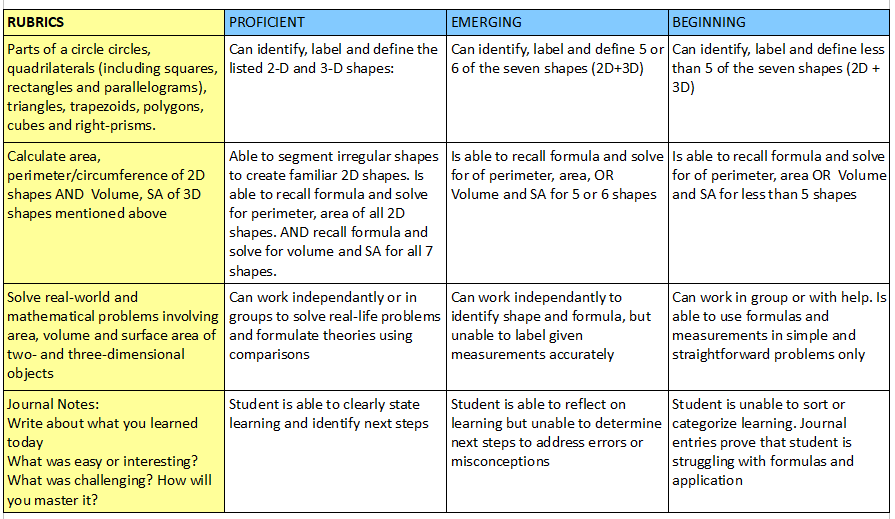
Start with the rubrics. Determine the end result that students must achieve. The rubric of Grade 7 includes the ability to define, label and identify parts of various 2D and 3D shapes, the ability to solve for area/perimeter OR surface area/volume in mathematical and real-life problems, and journal/self-reflect on individual progress.
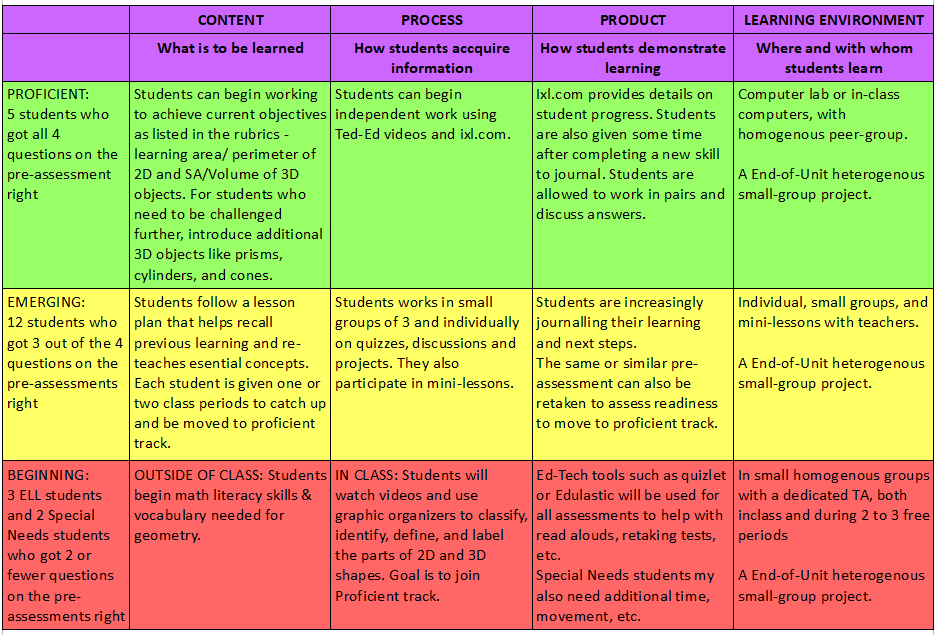
Then identify the differentiation practices in content, process, product, and learning environment. The goal for me was to bring every student to the proficient track. Given that 12 were in the Emerging and 5 were in the Beginning groups, extensive differentiation or accommodations were included in the process and learning environment.
MY DIFFERENTIATION PLAN:
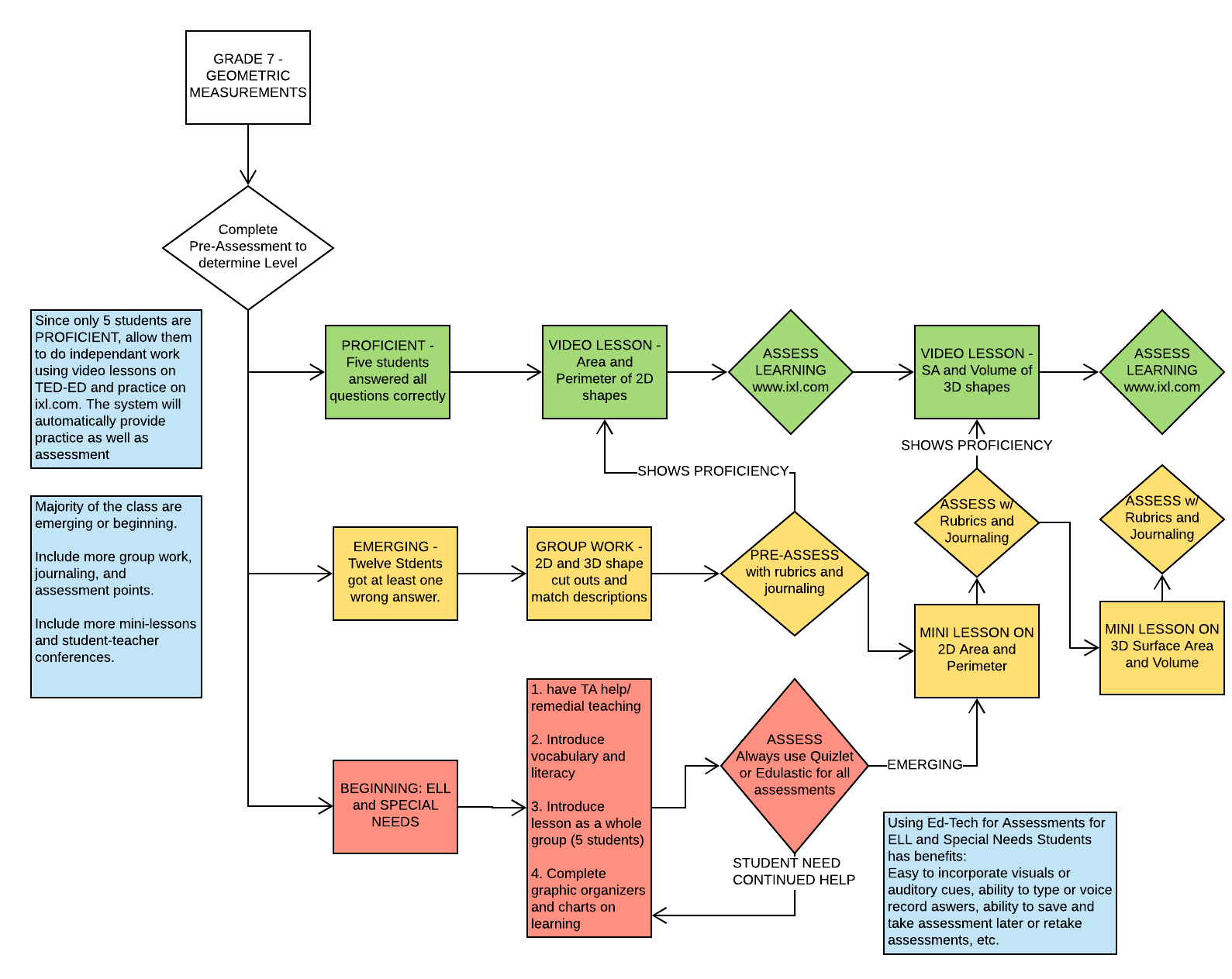
The flowchart shows the three levels or categories I’ve created based on the rubric are Proficient, Emerging, and Beginning. Proficient students have a lot of independent learning and peer-collaborations. The Emerging learners learn in small groups and individually on specific tasks designed to reteach information that can fast track them to Proficient. The Beginning students have one-on-one or remedial help beginning with math literacy and vocabulary essential to grasp concepts taught in the lesson. From there, students are assessed individually to evaluate readiness to move to Emerging and Proficient levels.
As mentioned earlier, the goal is to move every student to the Proficient bracket. Once this is achieved, the end-of-unit assessment is a PBL or inquiry-based project. Students will work in heterogeneous-small-groups for 5 to 10 days. They will use the knowledge learned to solve a real-life problem.
This is an essential step as “students are more engaged in school when social support for students is combined with a strong academic curriculum, which in turn significantly influences students’ motivation and learning (Turner, 2011).”
Here are some examples that can be used depending on the time available to complete the project:
- Community Building Project
- The Parchitecture Project
- Next Generation Spacecraft – Find the Surface Area of the Orion
- Build a Tiny House
Assessments during the PBL are also rubric based. Additional skills can be assessed, for instance, students working on the the Community Building Project have ratios and proportions built into it and will be assessed on these additional topics. Peer-evaluations will also be added to the assessment format. Overall, the project rubric will focus on students’ ability to work collaboratively, use the skills learned over the past weeks and their ability to produce a solution or end product.
REFERENCES:
Bish, Jamie, “A Project Based Learning Approach to Teaching Geometry in a 7th Grade Classroom” (2018). Education and Human Development Master’s Theses. 1044. Retrieved on 1/30/2019 from https://digitalcommons.brockport.edu/ehd_theses/1044
Finely, T. (2017, April 13). Teaching a Class With Big Ability Differences. Retrieved on 1/30/2019 from https://www.edutopia.org/article/teaching-class-big-ability-differences-todd-finley
Turner, S. L., (2011) Student-Centered Instruction: Integrating the Learning Sciences to Support Elementary and Middle School Learners, Preventing School Failure, 55(3), 123-131
Westman, L. (nd). Differentiation. Retrieved on 1/30/2019 from http://blogs.edweek.org/edweek/finding_common_ground/Differentiation.png


