The discussions of 21st Century Skills often begin and end with the 4 C’s: Communication, Collaboration, Critical Thinking, and Creativity. These four skills are thought to encompass a larger, more detailed framework. This article looks at three of the earliest frameworks created in the 1990s that focused on teaching 21st century skills in the classroom.
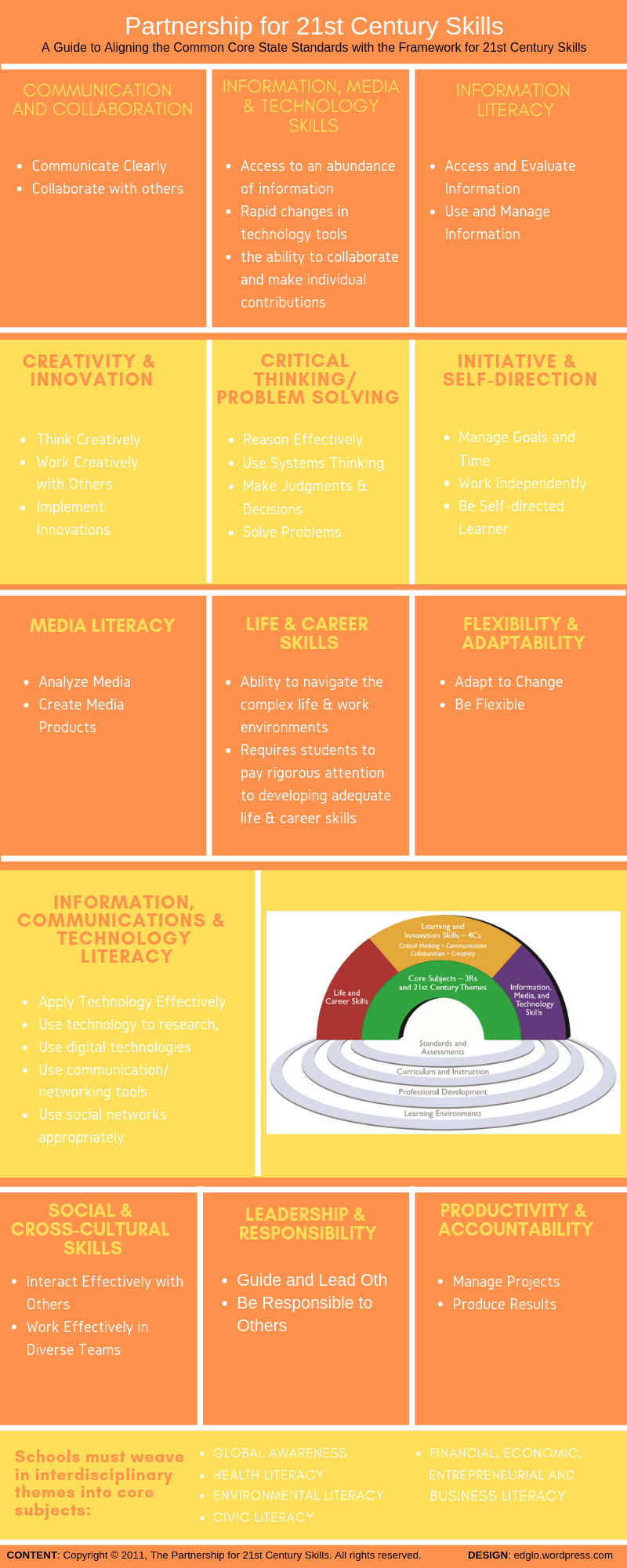
Partnership for 21st Century Skills (P21)
In 2002, The National Education Association (NEA), the largest labor union and professional interest group in the United States that is committed to the advancing public schools, helped create the Partnership for 21st Century Skills (P21).
P21 was tasked with the creating the framework for 21st century skills for public schools in the US. Around 2012 they published, “An Educators Guide to the “Four C’s”: Preparing 21st Century Students for a Global Community,” in which they explain how 4 C’s became synonymous with 21st Century Skills:
Over the years it became clear that the framework was too long and complicated. To resolve this issue, we interviewed leaders of all kinds to determine which of the 21st century skills were the most important for K-12 education. There was near unanimity that four specific skills were the most important. They became known as the “Four Cs”: Communication, Collaboration, Critical Thinking, and Creativity.
The framework created by P21 is woven into the Common Core Standards that are used in public school systems around the US since 2010.
The P21 Common Core Toolkit, another important publication by the NEA and P21, demonstrates how schools and teachers can combine teaching skills into their core lessons.
SCANS Report
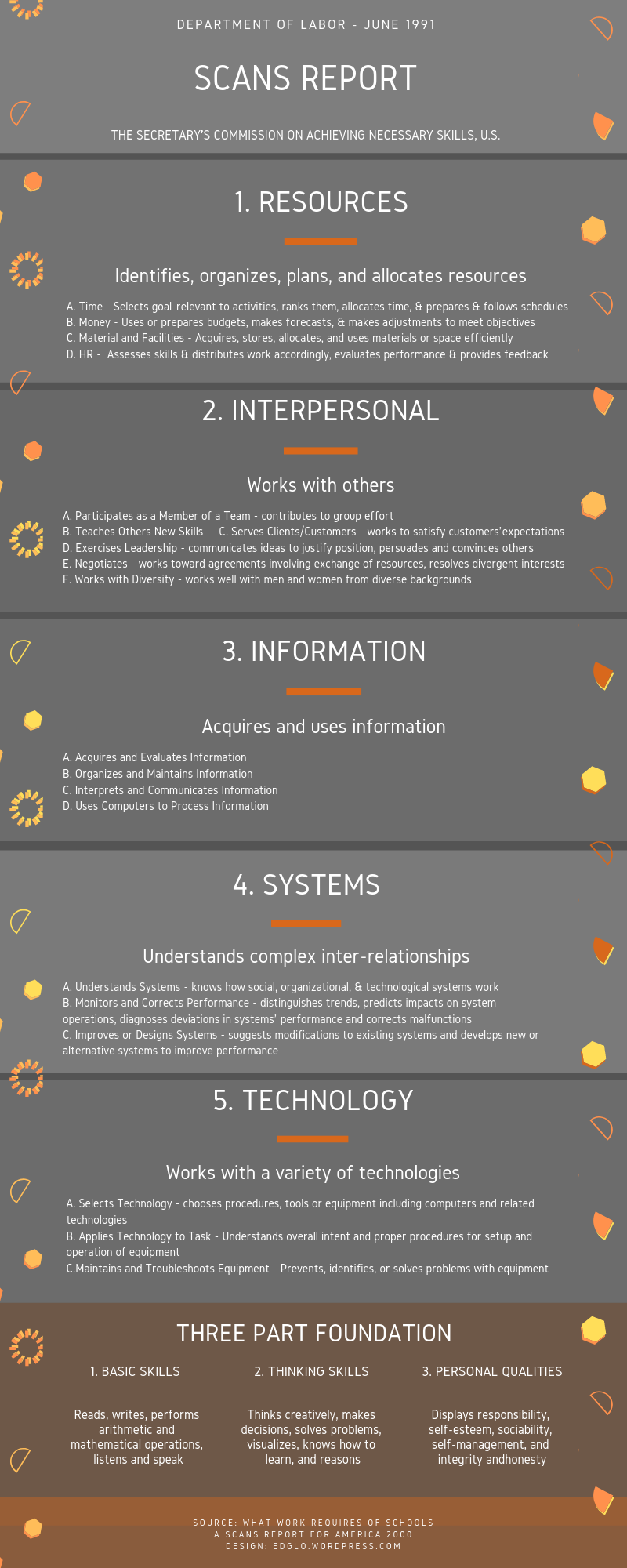
One of the earliest reports in the US, on building 21st Century Skills, dates back to 1991, over a decade before P21 was established. This report, nicknamed SCANS Report, was from the desk of the Secretary of the US Department of Labor, Lynn Martin. The Secretary’s Commission on Achieving Necessary Skills (SCANS), headed by William E. Brock, published the report identifying 5 SCANS competencies: Resource, Interpersonal, Information, Systems, and Technology, that “span the chasm between school and the workplace.” These 5 competencies were coupled with 3 foundational elements: the basic skills, higher order thinking skills, and diligent application of personal qualities.
The report started the conversations to overhaul the old 3 R’s – Reading, Writing, and Arithmetic. In addition to defining the 5 competencies and listing their characteristics, the report identified characteristics of “tomorrow’s workplace.” For instance, production in the traditional model would be based on fixed automation and end-of-line quality checks, but the high performance model of the future would call for flexible automation and on-line quality checks. In the traditional model, HR viewed workers as a cost but the high performance model would view workforce as an investment.
One of the challenges they took on was to create and define common vocabulary that everyone could use and understand. Though largely accepted, the report was still lacking. More basic definitions such as the meaning and/or difference between words such as, competency, foundational element, skill, and the rubrics to measure them were left undefined.
A paper presented in 1997, at the Valdosta State University, GA, by William Huit, suggested reorganizing the SCANS recommendations to include cognitive domain, affective domain, and the conative/volitional domain. These recommendations have all been implemented differently across the US schools – Public or Private.
OECD – DeSeCo Project
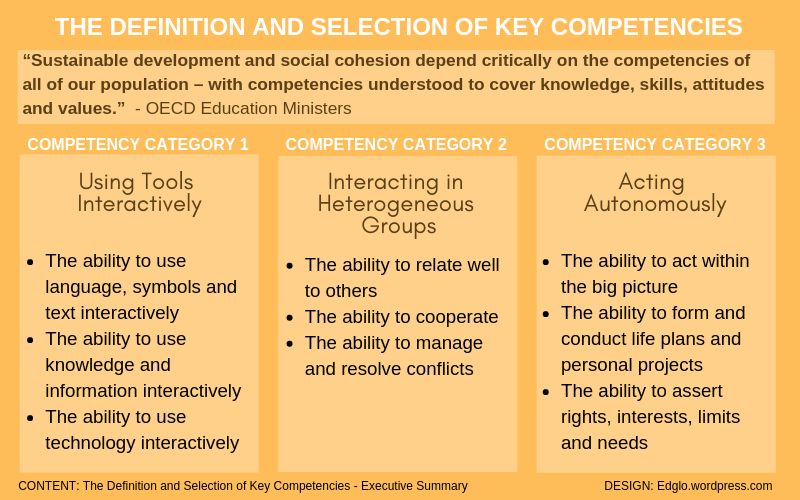
Between 1997 and 2003, the Organization for Economic Co-operation and Development (OECD) developed the Definition and Selection of Key Competencies Project (DeSeCo) framework. The key competencies included in the DeSeCo report aided life-long learning in three broad categories: Use Tools Interactively, Interact with Heterogeneous Groups, and Act Autonomously. 33 OECD countries set out to build national policies based on the Skills and Competencies identified and defined by the DeSeCo Project.
In 2009, Ananiyaduo and Claro completed a study commissioned by the OECD on DeSeCo implementation in the various OECD countries. This study highlighted the discrepancies, inconsistencies, and immeasurable policies being adopted by many countries. A key finding was the lack of clear definitions for basic terms like competencies, skills, and knowledge and a lack of measurable approaches or strategies. Currently, the OECD is working on a new and improved approach for Learning Framework for 2030.
Conclusion
One the key successes of the 21st Century Skills initiatives since the 1990’s is the undertaking by several governments, including the US, to create and develop national standards or national boards, like the Common Core, that incorporate a wide range of skill sets.
Despite the unceremonious welcome that Common Core received in it’s nascent years, it has the potential to unpack the evolution of education as it raises citizens of the global village.
REFERENCES
- Partnership for 21st Century Skills, (n.d.). P21 Common Core Toolkit: A Guide to Aligning the Common Core State Standards with the Framework for 21st Century Skills . Retrieved on 2/26/2019 from http://www.nea.org/home/ccss-toolkit.htm
- Partnership for 21st Century Skills, (n.d.) Preparing 21st Century Students for a Global Society: An Educator’s Guide to the “Four Cs”. Retrieved on 2/26/2019 fromhttp://www.nea.org/tools/52217.htm
- Organization for Economic Cooperation and Development (2005, May 27). The Definition and Selection of Key Competencies: Executive Summary. Retrieved on 2/26/2019 from http://www.oecd.org/education/skills-beyond-school/definitionandselectionofcompetenciesdeseco.htm
- Ananiadou, K. and M. Claro (2009), “21st Century Skills and Competences for New Millennium Learners in OECD Countries”, OECD Education Working Papers, No. 41, OECD Publishing. http://dx.doi.org/10.1787/218525261154
- US Department of Labor (1991, June). What Work Requires of Schools – The Secretary’s Commission on Achieving Necessary Skills Report for America 2000. Retrieved on 2/16/2019 from https://wdr.doleta.gov/SCANS/whatwork/whatwork.pdf
- Huitt, W. (1999, October). The SCANS report revisited. Paper delivered at the Fifth Annual Gulf South Business and Vocational Education Conference, Valdosta State University, Valdosta, GA, April 18, 1997. Retrieved [date], from http://www.edpsycinteractive.org/papers/scanspap.pdf
- Word Cloud: https://www.jasondavies.com/wordcloud/J


One thought on “Influence of P21, SCANS and DeSeCo on 21st Century Skills”