
For the past few weeks, I have been learning about formative assessments with my Teach Now cohort. My only experience prior to this class was the Formative Assessments (FA1, FA2, and FA3 tests) that most Indian schools following the CBSE curriculum would observe. A formative assessment in this traditional sense would evaluate student learning on a portion of the textbook, usually consisting of 3 to 4 lessons. Points and grades would be assigned and students and parents would find out which subjects are most challenging to the student. Another inevitable consequence is the promotion of a fixed mindset where students tend to believe they are bad at certain subjects and that’s just the way it is.
In striking contrast to the format I’ve seen in school systems, formative assessments are designed to accomplish two primary goals: assess student learning and inform teacher instruction for small chunks of a lesson involving 2 or 3 learning targets (LTs) or competencies.
Since the FA1, FA2 and FA3 system assess several chapters of a textbook at a time, the resulting data neither showcases collective or individual weaknesses in the LTs covered nor does it inform changes that need to be made to the instructional methods employed by the teacher.
Therefore, while selecting the three formative assessments for a 6th grade Math class, I used the following checklist:
- Will the assessment provide sufficient and clear data on each learning target
- Will the assessment showcase strengths and weaknesses that the students can map with the LTs by themselves
- Will the assessment showcase the common errors or individual student needs that need to be addressed by the teacher
- Can the assessment be turned into a routine that students will be comfortable with
Here are the three formative assessments I chose for my classroom.
- PRE-ASSESSMENTS: This formative assessment is used before a cluster of learning targets are introduced in order to check for prerequisite competencies. I opted to hand out a short quiz with questions covering select learning targets that the students should be familiar with. This would be useful in determining the student’s conceptual competencies. A peer review suggestion by Eric Dillion that I will be incorporating into the assessment is including open-ended questions like listing the connections and applications to the real world as they would provide better indicators to determine the level of student interest – which was an additional goal I wanted to achieve. Data collected with the pre-assessment would be directly used in determining my instructional strategy and methods of differentiation.
- SOCRATIC SEMINARS: The second formative assessment was a highly detailed and structured assessment that I would like to build into the weekly routine for the class. The frequency of the Socratic Seminars allows for continuous data collection as students demonstrate their learning at least once a week in a discussion with their peers and the teacher. There are a lot of steps involved in executing a Socratic Seminar, but establishing clear expectations and routines would add value to the process. Two main goals I wanted to achieve with this assessment are: Increase peer interactions where they learn from each other, and secondly, teach students to accurately determine their own learning gaps. There are several forms of feedback and evaluation associated with a Socratic Seminar: Self, Peer, and Teacher. All three provide clear and targeted feedback to the student. I’ve never had an opportunity to use this assessment (yet) since we were closed for the holidays. But with the new year and the new semester, I’m excited to introduce a new routine and see how the students respond.
- END-OF-UNIT TEST (FA1, FA2,…): Since these mandatory assessments are a part of the current system, I wanted to incorporate a method that might reduce the stress and anxiety associated with test taking for a grade. This assessment certainly provides many data points to evaluate teacher competency as well as student competency as it uses Edulastic, a tool that helps with formative assessments and data tracking. The use of the tool allows students to take the test online (or can be printed as a paper/pencil test), in a stress-free environment of their choice. Other benefits of Edulastic include the ability to assign a retest for students who may want to improve on their work, as well as the ability to inform parents/community of student progress. In addition to the Edulastic assessment, I included a Google Form with poll questions to determine if students felt prepared, challenged, positive, defeated, etc.. This addition was also included to address concerns shared by my instructor, Ms. Bookard, with Unit Tests being more summative than formative. The poll provides students an opportunity to reflect on their work and for me to determine if I need to consider revising, re-teaching, or re-testing any or all learning targets. Other options, instead of an online poll, is to conduct an activity like Last Word, where students present their reflections on the learning process, competencies mastered or the test-taking process, either in oral or written formats.
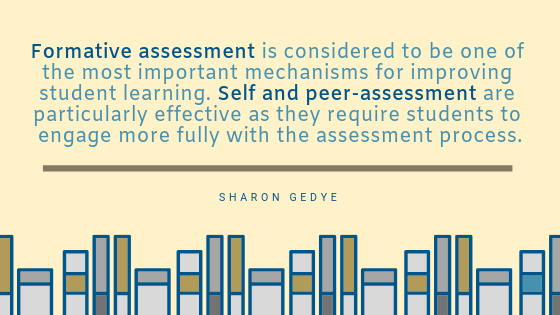
In conclusion, my formative assessments assess the needs of all stakeholders: student, teacher, community. The design aims to be data-driven, include feedback-rework loops, and be implemented with relative ease in my classroom.
REFERENCES:
Gedye, S. (2010). Formative assessment and feedback: a review, Planet, 23:1, 40-45, DOI 10.11120/plan.2010.00230040
[Common Sense Media] (2016, July 12) 3 Tips for Great Formative Assessment. Retrieved from https://www.youtube.com/watch?v=JJ5yRhyIeFI
“…include an opened ended question about why it’s important to learn the given material, how they will use it in the future and what they want to learn about the topic.” (Dillon, E. Personal Communication, Jan 3, 2019)

