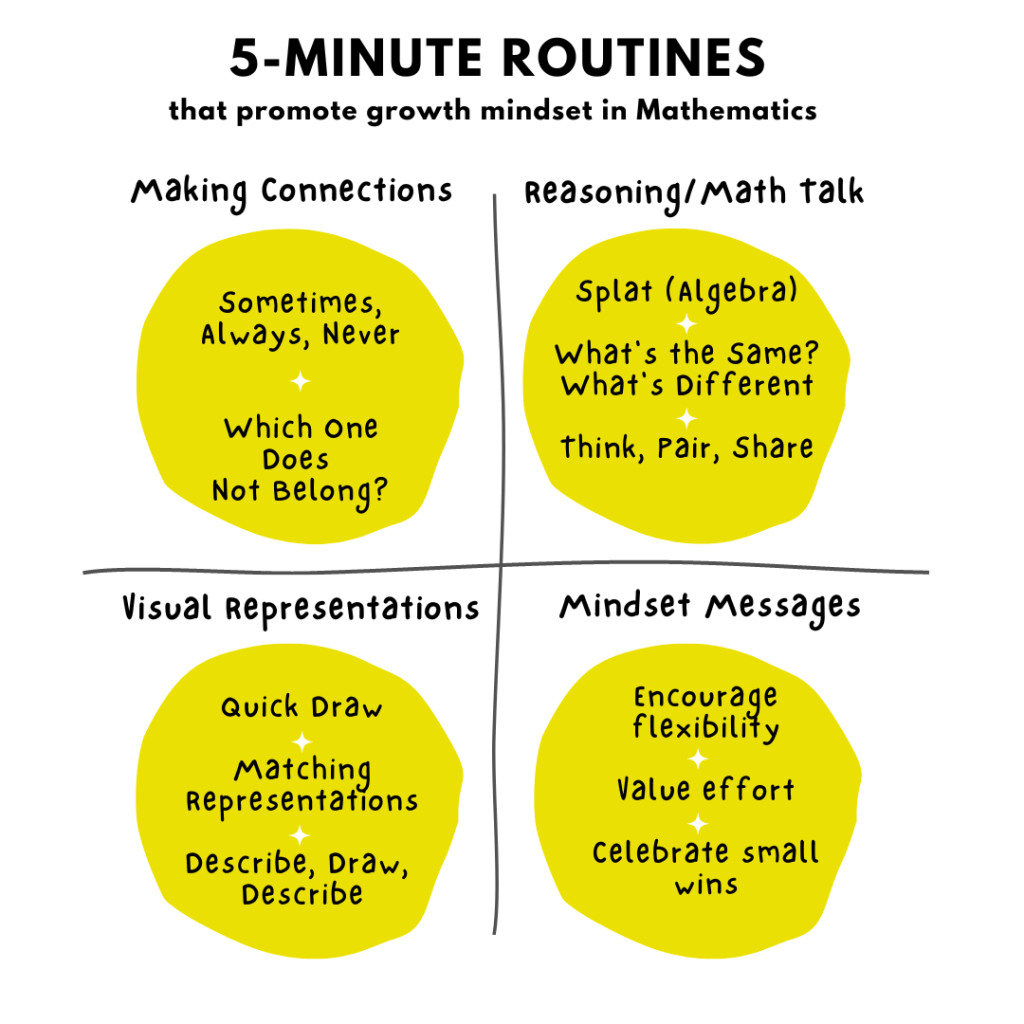
Here are some quick and engaging strategies to enhance your K12 math classroom that are sure to promote growth mindset and raise math enthusiasts.
Lazarus, A. Mathematics. Teachers Compass
If your math classroom needs a break from rigor and practice, try any of these 5-minute routines that can enhance student engagement and foster a no-fear and non-judgmental learning environment. These low-stakes routines are easy to incorporate and yet have huge benefits in learning outcomes. They can be used as entry and exit tickets or to build math fluency and stamina. The game-based nature will help students overcome math anxiety.
Making Connections:
To help seal in a concept, use activities like Sometimes, Always, Never and Which One Doesn’t Belong (WODB)
Sometimes, Always, Never: Consider the statement: A triangle can have more than 1 obtuse angle. Students have to determine if a statement is sometimes true, always true, or never true. Which means they need to know the definition of an obtuse angle and the triangle sum theorem. In this particular example, students will have to show negative cases as the statement is “never true.” This would work well as a think-pair-share activity that checks for understanding and increases retention.
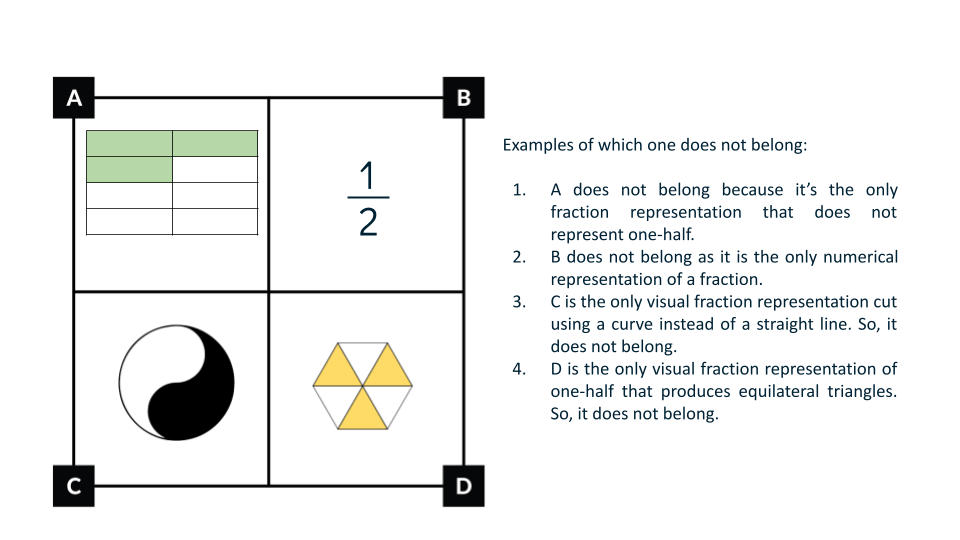
Which One Doesn’t Belong(WODB): This is a good low floor, high ceiling activity that encourages students to boldly make observations that increase their ability to think critically and develop a mathematical mindset. There are many examples of this activity on the internet because it demonstrates how math can actually have several answers and opens the mind of students to think outside the box. As you consider the example below, notice that you can find multiple ways to identify something that does not belong.
4 fraction representations that can be analyzed for WODB.
Reasoning/Math Talk:
These activities are primarily based on communication skills. Students learn to listen, observe, reflect, restate, reason, question, make mistakes, and try different approaches. Building computational fluency is only a secondary result of these activities. The primary focus is checking for understanding, and more importantly misunderstanding.
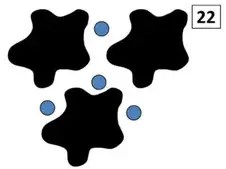
Splat! pattern for an algebraic expressionby Wyborney
Splat!: Created by Steve Wyborney, Splat! provides visual images that have a profound impact on students understanding algebraic concepts and the idea of variables. Solving for x can be a daunting task for many students who just don’t understand why a letter of the English alphabet was thrown in with numbers. This is one reason why Algebraic concepts are introduced in Middle School or higher. Splat! uses powers of observation to deconstruct the image and express it mathematically. As students get proficient, these tasks can be used to increase computation fluency as well. P.S. Check out other math activities in Mr. Wyborney’s blog that will get your students loving math.
What’s the same? What is different? (Same but Different) also provides students multiple ways to engage with a concept. For instance, consider the same rectangle cut differently. Students notice that the dimensions seem similar. They have to then think through different ways the pieces are similar or different. They can substitute real numbers and use computational reasoning to prove what is same or different. They can go one step a head and make another cut to see if the results are still the same. It provides many opportunities for math engagement.
Identifying similarities and differences in fractions by Dr. Looney
Think-Pair-Share: cooperative activity that encourages peer-learning and participation. However, for the activity to be beneficial, students should receive training or guidance. First, pick a math question that students can discuss with a partner. For instance the similar/different rectangles from the previous activity. Then, instructs students to draw/write their thoughts on a note card during the Think phase. Then have students pair up and take 1 minute each to Share their thoughts that they have penned down. After the initial share, each student is given 30 seconds to to share what they would change on their card based on their partners’ strategy. This ensures that students have actively listened and they use the knowledge gained to make adjustments to their own thinking or presentation.
Visual Representations:
Visualization opens a whole new world of learning to many students. The power of visual representations in mathematics is transformational as it provides a way to access abstract mathematical ideas and concepts. When students struggle to understand the importance of math in daily living, visual representations can bridge a gap that builds real-world connections. Here are routines that can build this skill:
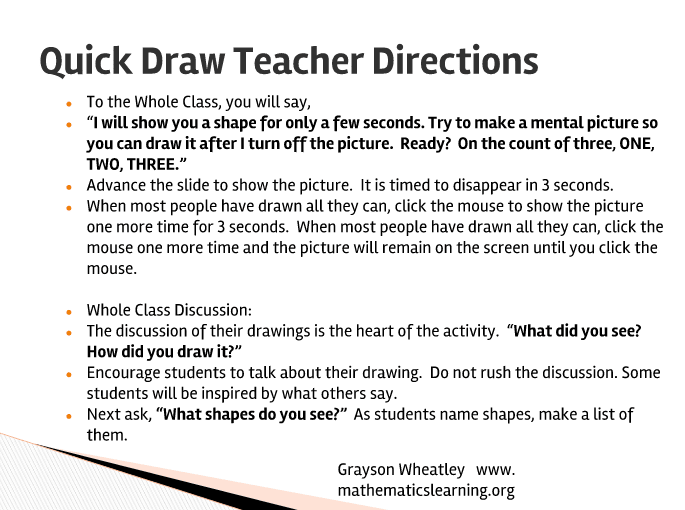
Quick Draw: Show students an image for 3 seconds and see if they can recreate it. Their ability to develop awareness of shapes, sizes, orientation, etc. increases spatial reasoning, pattern recognition, memorization and math literacy. Once the students have drawn the image, discuss what each of them saw and how they remembered what to draw. Kindergarten and elementary teachers are more inclined to use this method, how ever I’ve seen it used in high school calculus classes as well.
Wheatley, Grayson: Quick Draw Teacher Directions from mathequalslove.net
Matching Representations: Notice how visual representation routines are a continuation of making connections and fostering higher order thinking. In this routine you can have students dive deeper into these practices by providing a simple statement and asking them to represent it in multiple ways. This can be a small group activity to see how many different ways students were able to represent the same statement. This can be a frustrating task for students as they want to move on to the next question once they have found a solution. Your challenge will be to remain positive and encourage them to think of different possibilities. Use guiding questions to bring out contextual, visual, verbal, physical models that improve problem solving and communication skills as well.
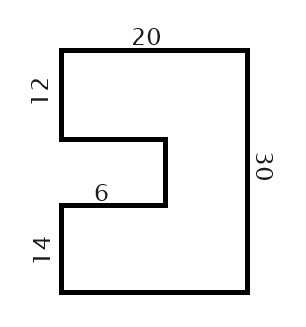
Statement: Find three different ways to solve for the area of the composite figure. Try using negative space strategy in one of your representations.
Which of the three representations you created is the quickest method to a solution?
Which of the three representations are you most likely to recollect next time and why?
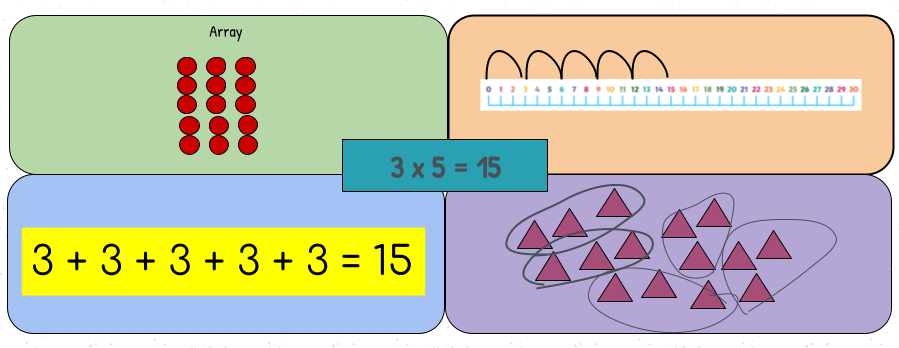
Statement: Find the solution to the following multiplication statement: 3 x 5 = 15
How would you use grouping to represent the statement?
Think of a real-world example where you can use grouping and multiplication to find the total.
Describe, Draw, Describe: If you want to try an alternative to Notice and Wonder routines, then Describe, Draw, Describe is for your classroom.
“I THINK IN PICTURES. Words are like a second language to me. I translate both spoken and written words into full-color movies, complete with sound, which run like a VCR tape in my head.” – Temple Grandin
This is a simple activity that is outrageously engaging and improves spatial awareness. The three simple steps for students are:
Describe what they see,
Draw what they see, and
Describe what they drew.
Paying attention to “seeing” is the key to this activity. Guiding to students to consider various aspects, describe it in their own words, and recreate it provides room for building language skills in mathematical contexts.
Mindset Messages
The power of positive messaging done correctly is immensely useful. This is not sugar coating failure or ignoring weaknesses, but, in my opinion, performing one of the most fundamental roles of a teacher – believing in our students. I know at various points in our career we have believed that a class is not for that student. I agree, not everyone is built to pay professional basketball, so stick to something else. To build a growth mindset, that can change the trajectory of a student’s achievement, we have to be able to guide them to be better versions of themselves each day.
Encourage Flexibility: Encourage students to try new things. Students like structure and consistency. Introducing small 5-minute tasks that disrupt that structure and consistency builds resilience and stamina to break structure and problem solve. Especially for students who are linear thinkers in Math and score high based on using the right algorithmic approach, flexibility is often regarded as an “unnecessary challenge.” My students often ask, “why fix something that is not broken?” Instead, I would like to think of flexibility as being comfortable with the unknown, enjoying the journey of making new discoveries, and sometimes stumbling on something life changing.
The focus was not on the right answer, but instead on the thinking and the courage to try.– Shelly Gray, Flexible Thinking
Value Effort: With decades of research now proving math achievement is related to a growth mindset over innate intelligence, it should be standard practice in our classrooms to value effort. Once again, this does not mean praising mediocrity or not holding students to high expectations. Valuing effort is actually noticed when students do not give up and hold themselves to higher standards because they have someone believing in their ability to do better. As a teacher, we can provide scaffolding, nurture curiosity, differentiate learning, and use an arsenal of tools to enhance learning experiences. These are our input into the classroom. However, valuing effort requires us to allow students to talk, discuss, show frustration, fail, try again, and engage in adding new tools to build their arsenal. It is easy to praise someone for getting a good grade that is evidenced by test scores; it is much harder to spot the greater value of progress when a student has made new discoveries through multiple failures.
imagine what can happen in a year of math class if students are given the right math materials and receive positive messages about their potential and ability. – Jo Boaler, Mathematical Mindset
Celebrate Small Wins: A challenge for teachers is to recognize growth in each student. It takes more effort especially when we have 40+ students in each class. Something I have personally tried is a 5-minute check-in each week with 5% of the lowest performing students where I review one completed task and listen to their challenge as well as their strategies to address it. It reminds the student that someone cares and is not giving up on them.
I have had teachers tell me they do not mind working closely with high-achieving (higher scoring) students, than supporting struggling students who seem to show little to no interest. Students may grow at a different pace, however, we have a duty to serve all students and find the wins for the ones who are struggling to find it on their own.
Share Your Classroom Strategies:
I hope you are intrigued by some of these strategies to explore and use them in your classrooms. There are several other routines and instructional practices that you may have used in your classroom that we can all learn from. Do share your own ideas and how you might have incorporated some of these ideas in your classroom.