To mix things up in the classroom, I recommend inviting guest teachers or even co-teaching with another teacher as it gets students excited. This past week I joined the G5 Math teacher as a guest teacher and here are some ways in which we chose to teach Factors, Multiples, and Divisibility Rules, and Squares over 3 days.
PLANNING PHASE
At our school, we have set aside 6 class periods for Math, where two are an 80-minute block. The first three days (including the block period) are used for teaching. The fourth day is assigned for formative assessments and the fifth day is set up as Support and Enrich based on the concept pioneered by Mesquite Elementary in Arizona, USA.
The Support and Enrich programs are based on the results of the formative assessment completed on Day 4. These results indicate students who need to revisit the lesson and students who have mastered the lesson. On Day 5, a different Math teacher reteaches the content that most students in the Support category struggled with on the formative assessment. While On the other hand, the students who were in the Enrich category are challenged with higher order problems. Often the Enrich group will pick up a book two grade levels above and reflect on how the lesson built on a spiral curriculum develops in higher grades.
PLAN FOR THE WEEK
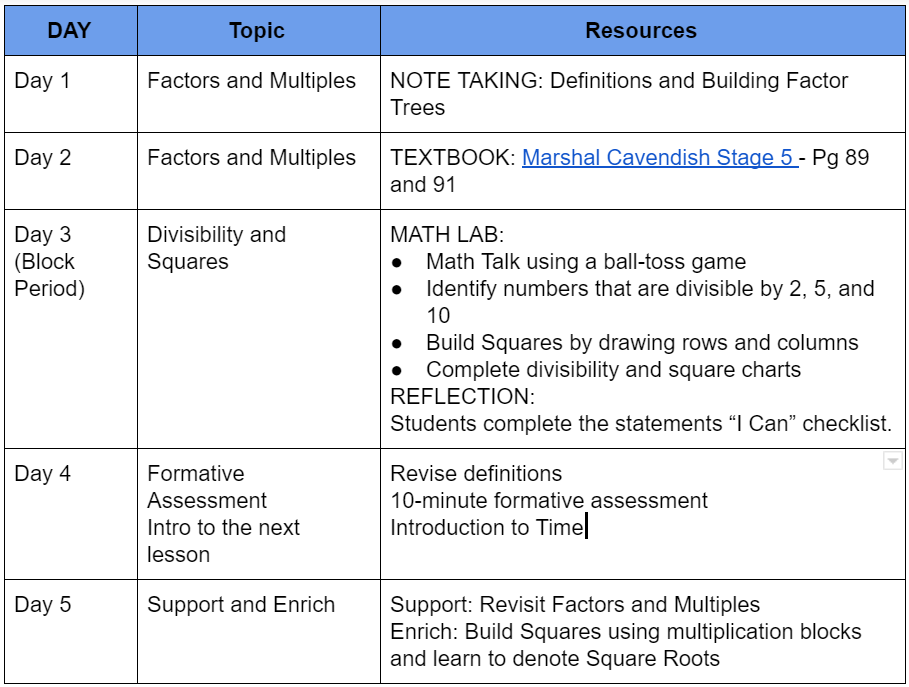
DAY 1:
- Bellwork (3 mins): Write on the board: Solve using long division. (1) 4713 divided by (2) 4713 divided by 3
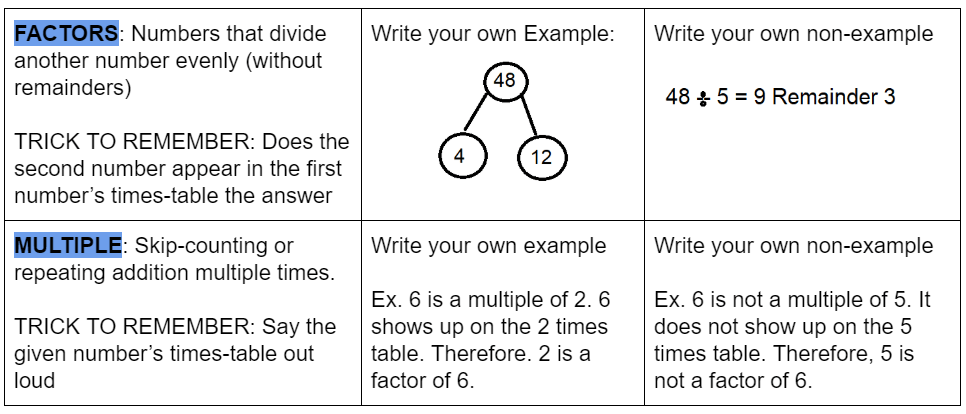
- Listening Time (5mins): Have students identify which of the two problems has a divisor that divides evenly. Use that example to explain factors
- Note Taking (20 mins): Have students draw and fill in the following table
- Pupil Book (10 mins): Read Page 88 and solve Page 89
- Homework (2 mins): Marshal Cavendish Activity Book (4 problems, max 15 minutes of reinforcement after school).
Day 2
- Bellwork (5 mins): Complete the Factor Trees for three numbers: (1) 74 (2) 125 (3) 250
- Note taking (5 mins): How do you find a missing factor when the second factors is given? (HINT: division)
- Marshal Cavendish Pupils Book Stage 5 (25 mins): Complete Pg 89 and Pg 91. Form clusters of three students each and allow the groups to work through the problems while the teacher(s) visit each group to assess if they have the right understanding
- Recap and Homework assignment (5 mins): Marshal Cavendish Activity Book (4 problems, max 15 minutes of reinforcement after school).
Day 3 – Block
- Math Talk with ball toss (15 mins): Write two sentence stems on the board: For the given number (ex. 10), say, “_________ is a factor of 10. And _______ is the multiple of 10.” Moderator has a ball. Moderator tosses the ball to a student and shouts out a number. The student with the ball incorporates the number into the sentence stems and provides answers. For ex. Moderator tosses the ball to Student 1 and says “25.” Student 1 says, “5 is a factor of 25. And 50 is a multiple of 25.” Then the student tosses the ball back to the moderator. This continues till all students have a chance. I would also do that game so that students turn into moderators after answering their questions correctly.
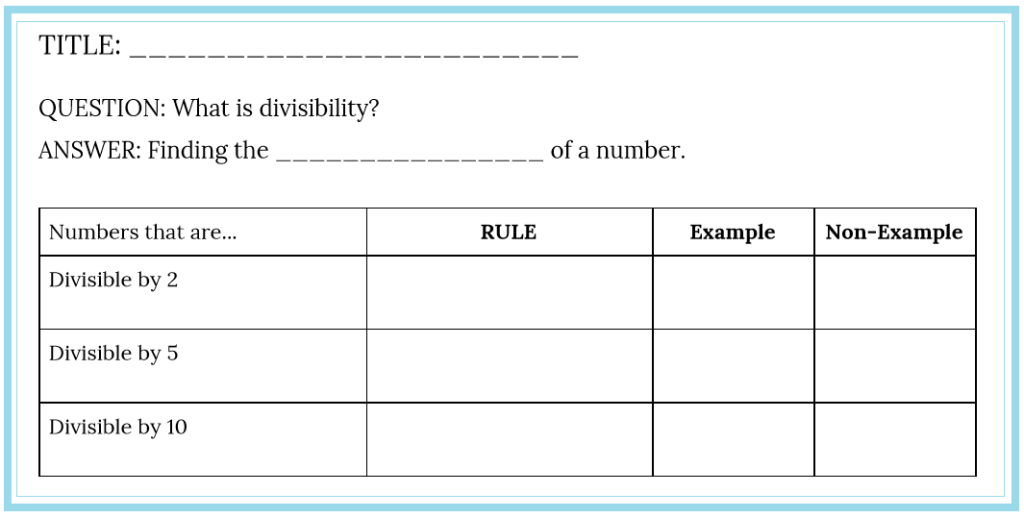
- Discussion (10 mins): Give examples of multiples of 2. What do these numbers have in common? Give examples of multiples of 5. What do these numbers have in common? Give examples of multiples of 10. What do these numbers have in common?
- Note Taking (15 mins): Stick the Divisibility Rule handout in your notebook and based on the discussion, complete the table.
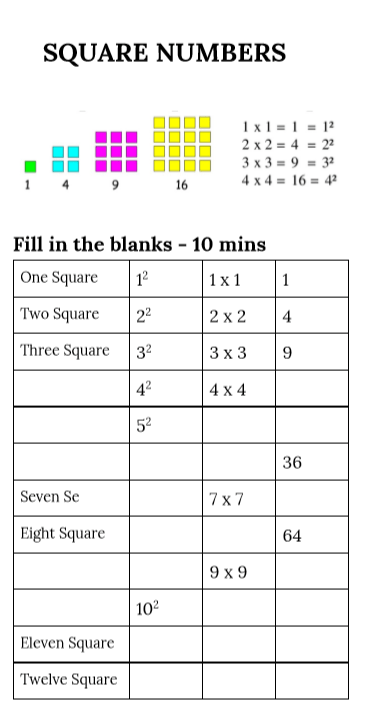
- Build Squares by Drawing Rows and Columns (10 mins): Represent 2×2, 3×3, and 4×4 by constructing squares. Count the small squares in the bigger square and see if the answers match the answers from the multiplication table.
- Note Taking (10 mins): Stick the Squares Chart in the notebook and complete the table.
- Recap (20 mins): As we’ve reached the end of the teaching phase, students sit in a circle to recap the learning objectives for the week. After a five-minute discussion, they are given a checklist to complete and assess their own learning. This step allows them to see if they are ready for the formative assessment the following day.
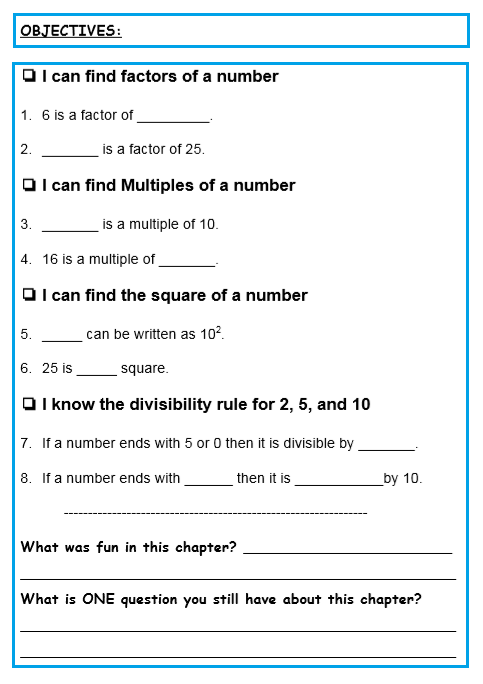
DAY 4: Formative assessment
- Bellwork – (1) 2718 x 9 (2) 2718 / 9
- Formatives – 10 to 15 minutes
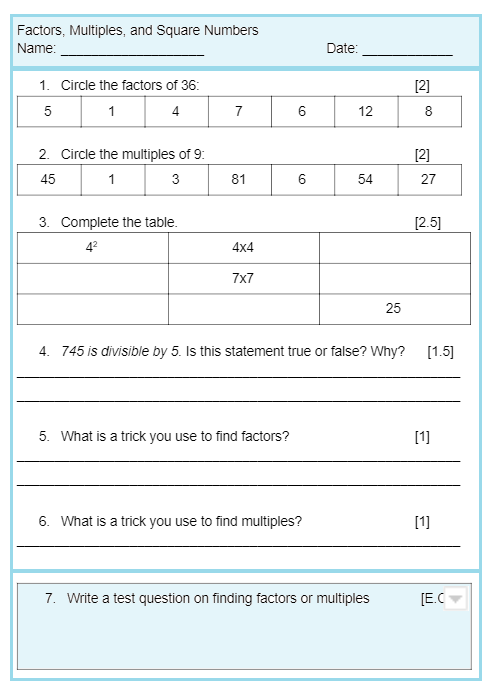
- Introduce next weeks topic. Grade and provide feedback on the paper instead of discussing the formatives in front of the class.
Day 5: Support & enrich
- Based on the understanding, not necessarily the scores, the class is divided into two groups: The support group consists of students who need a reteach, and the enrich group where the students are challenged in their knowledge of the subject.
IMAGES of the work done in class
THANK YOU: A big thank you to Ms. Archana for including me in her class and to the G5 students who were an amazing bunch of young mathaMAGICIANS!

