
First time teaching an online class? Awesome! You will find the tools, tips, and tricks you will need to establish your teaching practice online. We as teachers push our learners to actively participate in the learning process, to try new things and to never be afraid to fail. It’s our turn now to face this new challenge knowing that we have the support and help we need to succeed.
Before diving into Learning Management Systems and the myriad of educational apps and online resources available to you, consider the following 4 principles as a guide to choose and plan the right online class for you and your learners.
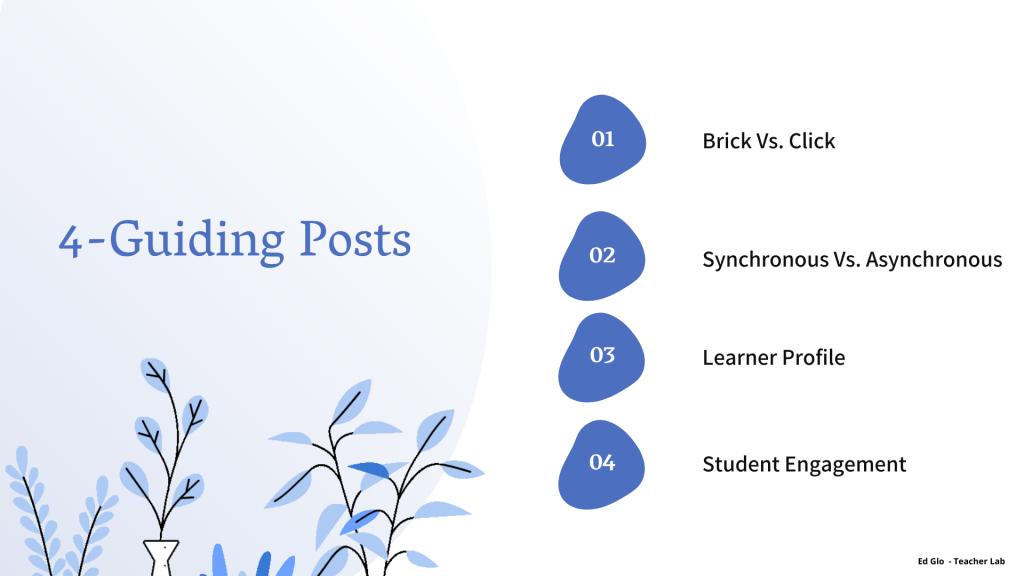
1. BRICK vs. CLICK
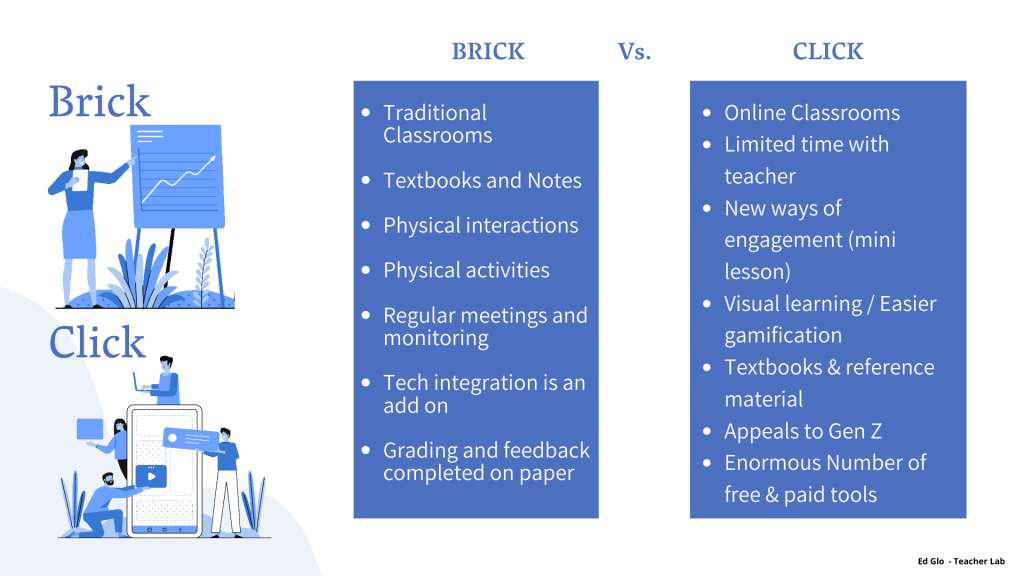
Firstly, these two terms allow us to consider the significant differences between traditional formats of teaching in “brick” classrooms and online teaching or a “click” classroom. As you prepare your lessons, consider the pros and cons of teaching in a “click” environment and how they compare to the “brick” environment. For instance, reading body language will be challenging on a Zoom call but on the flip-side learners will be developing self-study skills. Take a look at the differences listed below and add your own to the list provided below to reflect on the pros and cons of teaching online.
2. SYNCHRONOUS Vs. ASYNCHRONOUS ONLINE LEARNING
The second set of terms to consider are the two categories of online teaching and learning practices: Synchronous and Asynchronous.
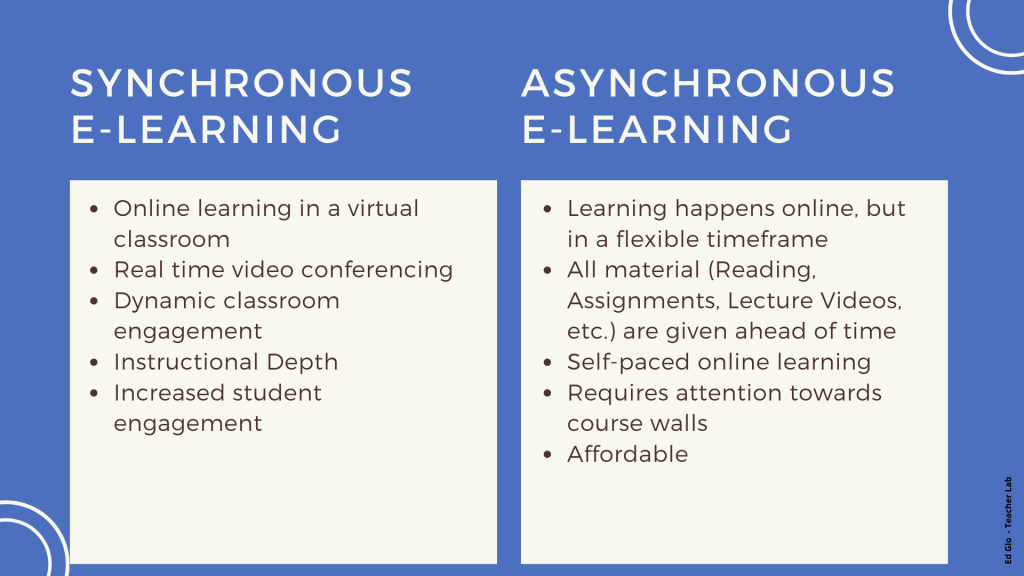
Synchronous teaching and learning take place in real-time. A meeting on Zoom or Google Meet, where the instructor gets to interact with learners is Synchronous teaching/learning. On the other hand, when material such as videos, voice notes, reading material, and assignments are uploaded in an online forum where learners can access it anytime and complete the assigned work is Asynchronous teaching/learning.
While student interactions are vital and can be supported through synchronous learning, consider issues like low bandwidth or access to computers and printers, and you’ll see the need for creating both synchronous and asynchronous learning opportunities for your students.
3. LEARNER PROFILE
When you imagine your learners succeeding in the traditional classroom environment, you have a picture of what success looks like. That attitude of insisting on high expectations from your students should not change in the click environment.
The Internation Society for Technology in Education (ISTE) lists seven student-centric standards for digital education. For this discussion, I’d like to focus on three of the standards that online teachers should build in their learners.
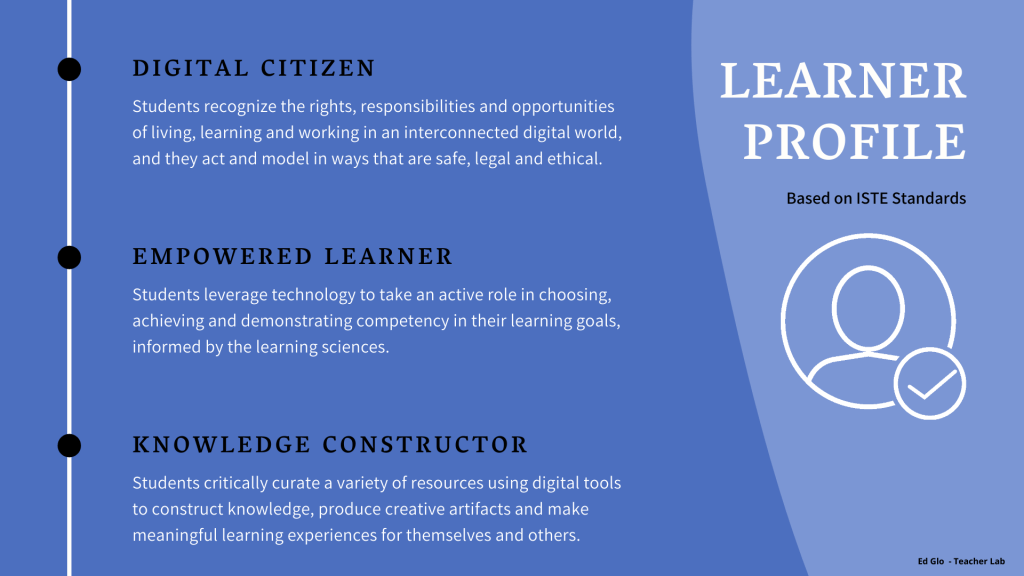
1. Digital Citizen: Students recognize the rights, responsibilities and opportunities of living, learning and working in an interconnected digital world, and they act and model in ways that are safe, legal and ethical.
ISTE Standards for Students
The rapid increase in screen time and access of various digital technology will have severe consequences on young learners if each of us as teachers do not take time to learn and impart safe ways in which to navigate this virtual world. Before ensuring that learners are understanding subject related content, we have a duty to create digital citizens who are not only tech-savvy but tech-safe.
2. Empowered Learner: Students leverage technology to take an active role in choosing, achieving and demonstrating competency in their learning goals, informed by the learning sciences.
ISTE Standards for Students
When the intrigue and novelty of a newly started online course wears off, the challenge to retain interests sets in.
Researchers Christensen and Spackman estimate that the dropout rate from online distance education classes is 10% to 20% more than dropout rates in face-to-face teaching, due to Course Walls – a segment of the course that is difficult and challenging to complete without the type of support system that learners would find within a traditional classroom.
Think of the age range of your learners and imagine the course walls they might hit. One of the surest way to encourage “leveraging technology” is to start becoming less hostile towards, and less confounded by the technology that surrounds us.
3. Knowledge Constructor: Students critically curate a variety of resources using digital tools to construct knowledge, produce creative artifacts and make meaningful learning experiences for themselves and others.
ISTE Standards for Students
A tech-coach colleague once shared that she often assigns an app to a group of students who have to use it and review the app by listing it’s primary features, pros, and cons. I thought that was an excellent idea!
If you are someone who does not enjoy trying to find the next app that would totally rock your class, then assign it to your learners and let them know that you accept their recommendations. You’ll be surprised how quickly things will change for you when learners become knowledge constructors.
I will be discussing all the ISTE standards for students along with examples for online classroom teaching in a future post. However, the three standards mentioned here serve up a clear picture of a digitally safe and savvy learner, who is empowered to understand their learning needs, and construct ways to impart or apply their knowledge.
4. STUDENT ENGAGEMENT
Having considered differences between brick and click learning, synchronous and asynchronous teaching, and the learner profile you want to envision for your students, you will need to begin designing your lessons.
In this new online environment of synchronous teaching, student engagement is key. Front of the class teaching and long lectures will have to be replaced with mini lessons and lots of student engagement.

While I work from home during the lockdown due to COVID-19, someone in the house will forget I’m in an online meeting and will barge in. While the “comfort” of working from home has advantages, we – male or female teachers – are all literally working two jobs at once. Caring for our families and trying to work at the same time, in the same space, will come with distractions. Imagine similar situations for your learners.
So, while considering student engagement, think of ways to create a check-in system, or how they can come prepared for a collaborative online activity or what reflection questions can be introduced during the synchronous meeting.
Mastering student engagement will help you navigate the most challenging of issues online teachers face – attrition.
My next post will address planning and communicating weekly lessons with learners. For now, keeping the best interest of your student in mind, look back on these four ideas and reflect on what your next steps might be.
REFERENCES
Christensen, Steven & Spackman, Jonathan. (2017). Dropout Rates, Student Momentum, and Course Walls: A New Tool for Distance Education Designers. Journal of Educators Online. 14. 10.9743/jeo.2017.14.2.7.
Tomar, D. A. (2018, Jan 31). Synchronous Learning vs. Asynchronous Learning in Online Education. https://thebestschools.org/magazine/synchronous-vs-asynchronous-education/
Presentation slides created in Canva.com.
Feel free to share the presentation with fellow teachers and your school. There is no cost for using the material. Appreciate if you would include credit while distributing any material created by EdGloLab.

